

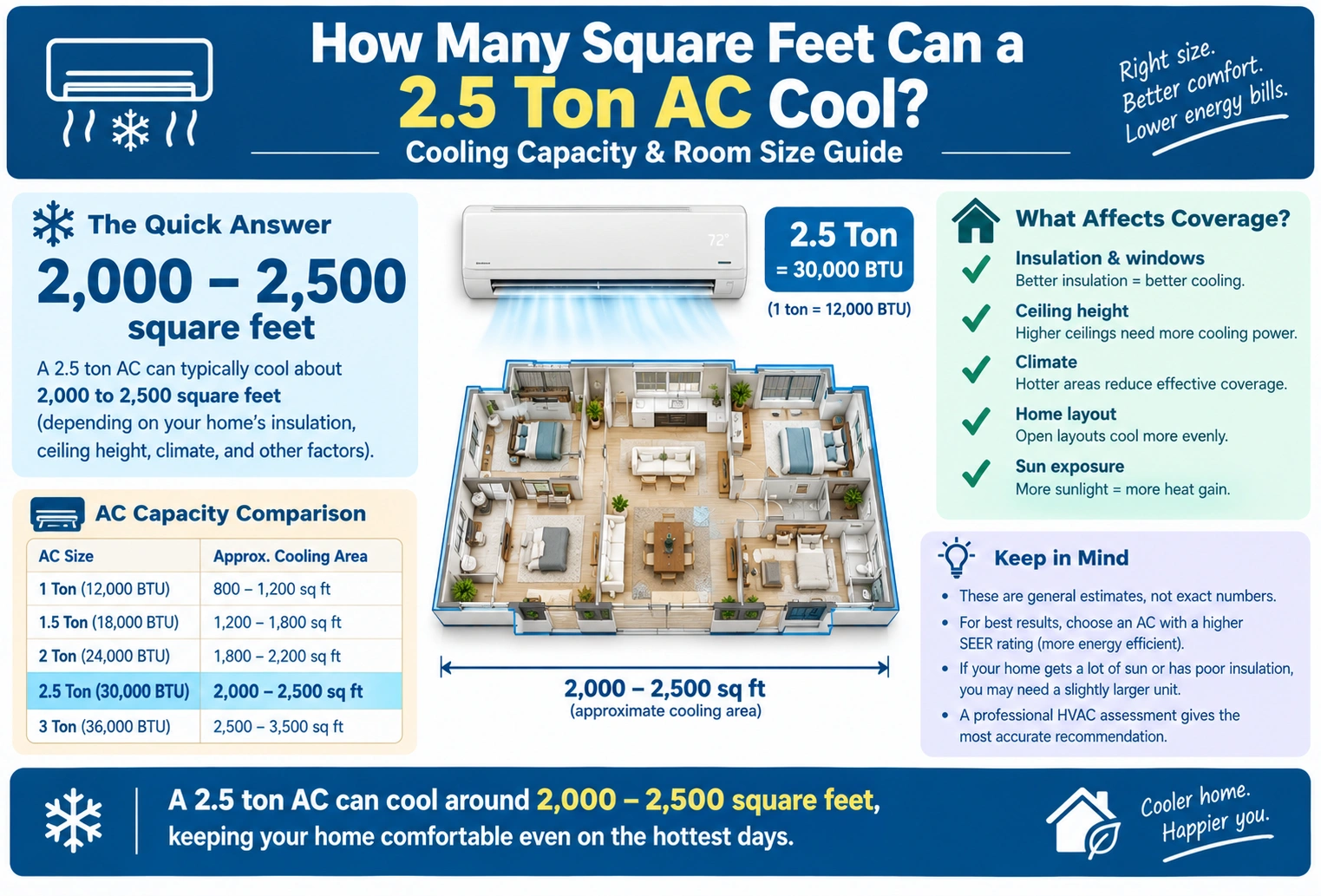
A 2.5-ton air conditioner provides approximately 30,000 BTUs of cooling capacity and can typically cool around 1,200 to 1,500 square feet under common residential conditions.
However, square footage alone does not determine the correct AC size.
The amount of space a 2.5-ton AC can effectively cool depends on factors such as:
- Climate
- Insulation
- Ceiling height
- Number and size of windows
- Sun exposure
- Number of occupants
- Home layout
- Ductwork
- Air leakage
- Building construction
| 2.5 Ton AC Information | Typical Value |
|---|---|
| AC capacity | 2.5 tons |
| Cooling capacity | 30,000 BTU/hr |
| Common residential coverage | 1,200–1,500 sq ft |
| Potential coverage in favorable conditions | Up to about 1,600 sq ft |
| Potential coverage in very hot conditions | May be closer to 1,000–1,200 sq ft |
The 1,200–1,500 square-foot range is a general planning estimate, not a replacement for an HVAC load calculation.
How Many BTUs Is a 2.5 Ton AC?
One ton of air-conditioning capacity is conventionally equal to 12,000 BTUs per hour.
Therefore:
2.5 × 12,000 = 30,000 BTU/hr
A 2.5-ton AC has a nominal cooling capacity of approximately 30,000 BTUs per hour.
| AC Size | Approximate Cooling Capacity |
|---|---|
| 1 ton | 12,000 BTU/hr |
| 1.5 tons | 18,000 BTU/hr |
| 2 tons | 24,000 BTU/hr |
| 2.5 tons | 30,000 BTU/hr |
| 3 tons | 36,000 BTU/hr |
| 3.5 tons | 42,000 BTU/hr |
| 4 tons | 48,000 BTU/hr |
| 5 tons | 60,000 BTU/hr |
The term “ton” does not refer to the physical weight of the air conditioner. It is a measure of cooling capacity.
How Many Square Feet Can a 2.5 Ton AC Cool?
A 2.5-ton AC is commonly suitable for approximately 1,200 to 1,500 square feet of residential space, depending heavily on the home’s cooling load.
A well-insulated house in a moderate climate may be able to use a 2.5-ton unit for more square footage than a poorly insulated house in an extremely hot climate.
| Home Size | 2.5 Ton AC Suitability |
|---|---|
| 800 sq ft | Usually more than sufficient |
| 1,000 sq ft | Generally ample capacity |
| 1,200 sq ft | Often a good fit |
| 1,300 sq ft | Often suitable |
| 1,400 sq ft | Can be suitable |
| 1,500 sq ft | May be suitable depending on load |
| 1,600 sq ft | Requires careful load evaluation |
| 1,800 sq ft | Often requires more capacity, depending on conditions |
These figures should be used for general understanding rather than as a final equipment-selection rule.
A professional HVAC sizing calculation considers the actual heat entering the building instead of simply applying a square-foot-per-ton rule.
2.5 Ton AC Size by Climate
Climate can have a major effect on the amount of cooling required.
A home in a mild climate may require less cooling capacity than an identical home exposed to extremely high outdoor temperatures.
| Climate / Conditions | Approximate Area a 2.5 Ton AC May Handle |
|---|---|
| Mild climate + good insulation | 1,400–1,600+ sq ft |
| Moderate climate + average insulation | 1,200–1,500 sq ft |
| Warm climate | 1,100–1,400 sq ft |
| Hot climate | 1,000–1,300 sq ft |
| Very hot + poor insulation | May require less than 1,200 sq ft |
These ranges are illustrative rather than design specifications.
For example, two houses with exactly 1,500 square feet can require different AC capacities if one has excellent insulation and shaded windows while the other has poor insulation, large sun-facing windows, and a high ceiling.
Can a 2.5 Ton AC Cool 1,500 Square Feet?
Yes, a 2.5-ton AC can cool a 1,500-square-foot house under the right conditions.
However, 1,500 square feet is near the upper end of the commonly suggested range for a 2.5-ton residential AC.
Whether it works well depends on the home’s actual cooling load.
| Home Condition | 2.5 Ton AC for 1,500 Sq Ft |
|---|---|
| Excellent insulation | More likely to be suitable |
| Moderate insulation | Potentially suitable |
| Poor insulation | May be undersized |
| Mild climate | More favorable |
| Hot climate | More demanding |
| Low ceilings | More favorable |
| High ceilings | More cooling may be needed |
| Shaded windows | Reduces heat gain |
| Large sunny windows | Increases heat gain |
If the house has high heat gain, a 2.5-ton unit may run continuously without adequately maintaining the desired indoor temperature.
Can a 2.5 Ton AC Cool 1,200 Square Feet?
A 2.5-ton AC is often a reasonable size for a 1,200-square-foot home, assuming typical construction and a suitable climate.
At 30,000 BTU/hr, the unit provides substantial cooling capacity for a relatively modest residential floor area.
However, it is still possible for a 1,200-square-foot home to require a different size.
For example, a poorly insulated home with extensive windows and high ceilings can have a significantly higher cooling load than a well-insulated home of the same size.
2.5 Ton AC Compared With Other AC Sizes
Comparing different AC sizes can help show where a 2.5-ton system fits.
| AC Size | BTU/hr | General Residential Area* |
|---|---|---|
| 1.5 ton | 18,000 | 600–900 sq ft |
| 2 ton | 24,000 | 800–1,200 sq ft |
| 2.5 ton | 30,000 | 1,200–1,500 sq ft |
| 3 ton | 36,000 | 1,400–1,800 sq ft |
| 3.5 ton | 42,000 | 1,600–2,100 sq ft |
| 4 ton | 48,000 | 1,800–2,400 sq ft |
| 5 ton | 60,000 | 2,200–3,000 sq ft |
*Area ranges are broad planning estimates. Actual required capacity can differ substantially based on climate, construction, insulation, windows, occupancy, and other factors.
The table should not be interpreted as meaning that every 1,500-square-foot home needs a 2.5-ton unit or that every 1,800-square-foot home needs a 3-ton unit.
Factors That Affect How Much Area a 2.5 Ton AC Can Cool
Climate
Outdoor temperature and humidity affect the amount of heat entering a home.
A house in a hot climate generally requires more cooling capacity than a similar house in a mild climate.
Insulation
Good insulation reduces heat transfer between the outside and inside.
| Insulation Condition | Effect on Cooling Demand |
|---|---|
| Excellent | Lower cooling demand |
| Good | Generally favorable |
| Average | Moderate demand |
| Poor | Higher cooling demand |
A well-insulated 1,500-square-foot house may be easier to cool than a poorly insulated 1,200-square-foot house.
Windows
Windows can be a significant source of solar heat gain.
Large windows facing strong afternoon sunlight can increase the cooling load.
Window characteristics that matter include:
- Size
- Orientation
- Glass type
- Number of panes
- Shading
- Curtains or blinds
Ceiling Height
Square footage measures floor area, but air conditioners cool a volume of air.
A home with 8-foot ceilings has substantially less interior volume than the same floor area with 12-foot ceilings.
| Home | Floor Area | Ceiling Height | Air Volume |
|---|---|---|---|
| Example A | 1,200 sq ft | 8 ft | 9,600 cu ft |
| Example B | 1,200 sq ft | 10 ft | 12,000 cu ft |
| Example C | 1,200 sq ft | 12 ft | 14,400 cu ft |
This is one reason floor area alone cannot determine the correct AC capacity.
Number of Occupants
People generate heat inside a building.
A home occupied by more people may have a higher cooling load than an otherwise identical home with fewer occupants.
Appliances and Lighting
Heat produced by appliances, electronics, lighting, and other equipment can contribute to indoor cooling demand.
Ductwork
The condition and design of the duct system also matter.
Poorly insulated or leaking ducts can reduce the amount of cooling that actually reaches the living spaces.
How to Tell if a 2.5 Ton AC Is the Right Size
The most reliable approach is a professional cooling-load calculation, commonly based on the Manual J methodology used in residential HVAC design.
Rather than selecting an air conditioner solely from the home’s square footage, the calculation considers factors such as:
| Factor | Considered in Proper Sizing |
|---|---|
| Floor area | Yes |
| Climate | Yes |
| Insulation | Yes |
| Windows | Yes |
| Window orientation | Yes |
| Ceiling height | Yes |
| Building construction | Yes |
| Occupancy | Yes |
| Internal heat sources | Yes |
| Air infiltration | Yes |
This approach helps avoid both undersizing and oversizing.
What Happens if a 2.5 Ton AC Is Too Small?
If a 2.5-ton AC does not have enough capacity for the home’s cooling load, it may struggle during hot weather.
Potential signs include:
- Long or nearly continuous run times
- Difficulty reaching the thermostat setting
- Warm rooms
- Uneven cooling
- Higher energy consumption
- Excessive system strain
An undersized unit is not necessarily inefficient in every circumstance, but insufficient capacity can become especially noticeable during peak outdoor temperatures.
What Happens if a 2.5 Ton AC Is Too Large?
Installing a larger AC is not automatically better.
An oversized system can cool the air quickly but may not run long enough to remove humidity effectively.
Potential problems can include:
- Short cycling
- Uneven temperatures
- Poor humidity control
- Increased wear
- Less comfortable indoor conditions
This is why selecting the correct capacity is more important than simply choosing the biggest available unit.
2.5 Ton AC for Different House Sizes
The following table provides a simple planning reference.
| House Size | General 2.5 Ton AC Assessment |
|---|---|
| 900 sq ft | Usually plenty of capacity |
| 1,000 sq ft | Generally sufficient |
| 1,100 sq ft | Generally favorable |
| 1,200 sq ft | Often suitable |
| 1,300 sq ft | Often suitable |
| 1,400 sq ft | Depends on cooling load |
| 1,500 sq ft | Possible with favorable conditions |
| 1,600 sq ft | Requires careful evaluation |
| 1,700 sq ft | May be undersized |
| 1,800 sq ft | Often consider additional capacity |
Again, these are not substitutes for a professional load calculation.
A 2.5-ton unit’s actual suitability can change substantially depending on climate and building characteristics.
2.5 Ton AC vs. 3 Ton AC
The difference between these two common sizes is 6,000 BTU/hr.
| Feature | 2.5 Ton AC | 3 Ton AC |
|---|---|---|
| Nominal capacity | 30,000 BTU/hr | 36,000 BTU/hr |
| Difference | — | 6,000 BTU/hr more |
| Typical use | Smaller/lower-load homes | Larger/higher-load homes |
| Square-foot range | About 1,200–1,500* | About 1,400–1,800* |
*General planning ranges only.
Choosing between 2.5 and 3 tons should be based on the actual cooling requirement rather than assuming that the larger unit will always provide better performance.
Does a 2.5 Ton AC Use a Lot of Electricity?
A 2.5-ton AC has a higher potential power demand than smaller units, but actual electricity use depends on several factors.
| Factor | Effect on Electricity Use |
|---|---|
| AC efficiency rating | Higher efficiency can reduce consumption |
| Outdoor temperature | Higher temperatures can increase demand |
| Thermostat setting | Lower settings generally increase cooling demand |
| Insulation | Better insulation can reduce demand |
| Windows | High solar gain can increase demand |
| Runtime | Longer operation uses more electricity |
| Duct condition | Leaks can reduce efficiency |
| Maintenance | Dirty filters/coils can affect performance |
Therefore, you cannot determine monthly electricity consumption from the 2.5-ton rating alone.
Common Mistakes When Choosing a 2.5 Ton AC
Mistake 1: Using Only Square Footage
Square footage is useful for a rough estimate, but it does not account for all of the factors affecting cooling load.
Mistake 2: Assuming Bigger Is Better
A larger AC can create humidity-control and short-cycling problems if it is significantly oversized.
Mistake 3: Ignoring Climate
The same house can require different AC capacities in different climates.
Mistake 4: Ignoring Insulation
Poor insulation can substantially increase cooling demand.
Mistake 5: Confusing Tons With Weight
An AC’s tonnage describes its cooling capacity, not how much the equipment weighs.
Mistake 6: Assuming 30,000 BTUs Guarantees a Specific Square-Foot Coverage
A 30,000-BTU system does not automatically cool the same number of square feet in every building.
FAQs
How many square feet can a 2.5 ton AC cool?
A 2.5-ton AC can typically cool around 1,200 to 1,500 square feet, depending on climate, insulation, windows, ceiling height, and other factors.
How many BTUs is a 2.5 ton AC?
A 2.5-ton AC provides approximately 30,000 BTUs per hour of nominal cooling capacity.
Is a 2.5 ton AC enough for 1,500 square feet?
It can be, particularly in a well-insulated home with favorable conditions. However, 1,500 square feet is near the upper end of the typical range, so a proper cooling-load calculation is recommended.
Is a 2.5 ton AC enough for 1,200 square feet?
A 2.5-ton unit is often suitable for a 1,200-square-foot home, although the actual requirement depends on the home’s cooling load.
What size AC do I need for 1,500 square feet?
There is no universal answer based solely on square footage. A 2.5-ton unit may be appropriate in some homes, while others may require a different capacity because of climate, insulation, windows, ceiling height, and other factors.
Is 30,000 BTUs enough for a house?
It depends on the house. A 30,000-BTU system can be appropriate for many homes in the roughly 1,200–1,500-square-foot range, but the actual cooling load determines the required capacity.
Is a 2.5 ton AC bigger than a 2 ton AC?
Yes. A 2.5-ton AC has a nominal capacity of 30,000 BTU/hr, while a 2-ton unit has approximately 24,000 BTU/hr.
How much more powerful is a 3 ton AC than a 2.5 ton AC?
A 3-ton AC provides approximately 36,000 BTU/hr, compared with 30,000 BTU/hr for a 2.5-ton unit. The difference is 6,000 BTU/hr.
Can a 2.5 ton AC cool 1,800 square feet?
It may not provide enough capacity for an 1,800-square-foot home, particularly in a hot climate or a home with high heat gain. A load calculation should determine the appropriate size.
Does a 2.5 ton AC cool better than a 2 ton AC?
A 2.5-ton AC has greater nominal cooling capacity than a 2-ton unit, but that does not mean it will perform better in every home. The best system is one correctly matched to the home’s cooling load.
Conclusion
A 2.5-ton air conditioner has approximately 30,000 BTUs of cooling capacity and can commonly cool around 1,200 to 1,500 square feet in residential applications.
| Key Information | 2.5 Ton AC |
|---|---|
| Nominal capacity | 30,000 BTU/hr |
| Common coverage | 1,200–1,500 sq ft |
| 1,200 sq ft home | Often suitable |
| 1,500 sq ft home | Potentially suitable |
| 1,800 sq ft home | May be undersized |
| Main sizing factors | Climate, insulation, windows, ceilings, occupancy, layout |
The most important point is that AC sizing should not be based on square footage alone. A 1,500-square-foot home with excellent insulation and limited solar exposure can have a very different cooling requirement from a poorly insulated 1,500-square-foot home in a hot climate.
If you’re deciding whether a 2.5-ton AC is appropriate, use the 30,000-BTU capacity as a starting point, then have the home’s actual cooling load evaluated before selecting the equipment.
Discover More Articles
How Many Feet Is 109 Yards? Exact Conversion Guide