
If you’re planning a driveway, patio, sidewalk, shed foundation, or any other concrete project, you may be asking how many square feet is a yard of concrete. This is one of the most common questions homeowners and contractors ask when estimating materials.
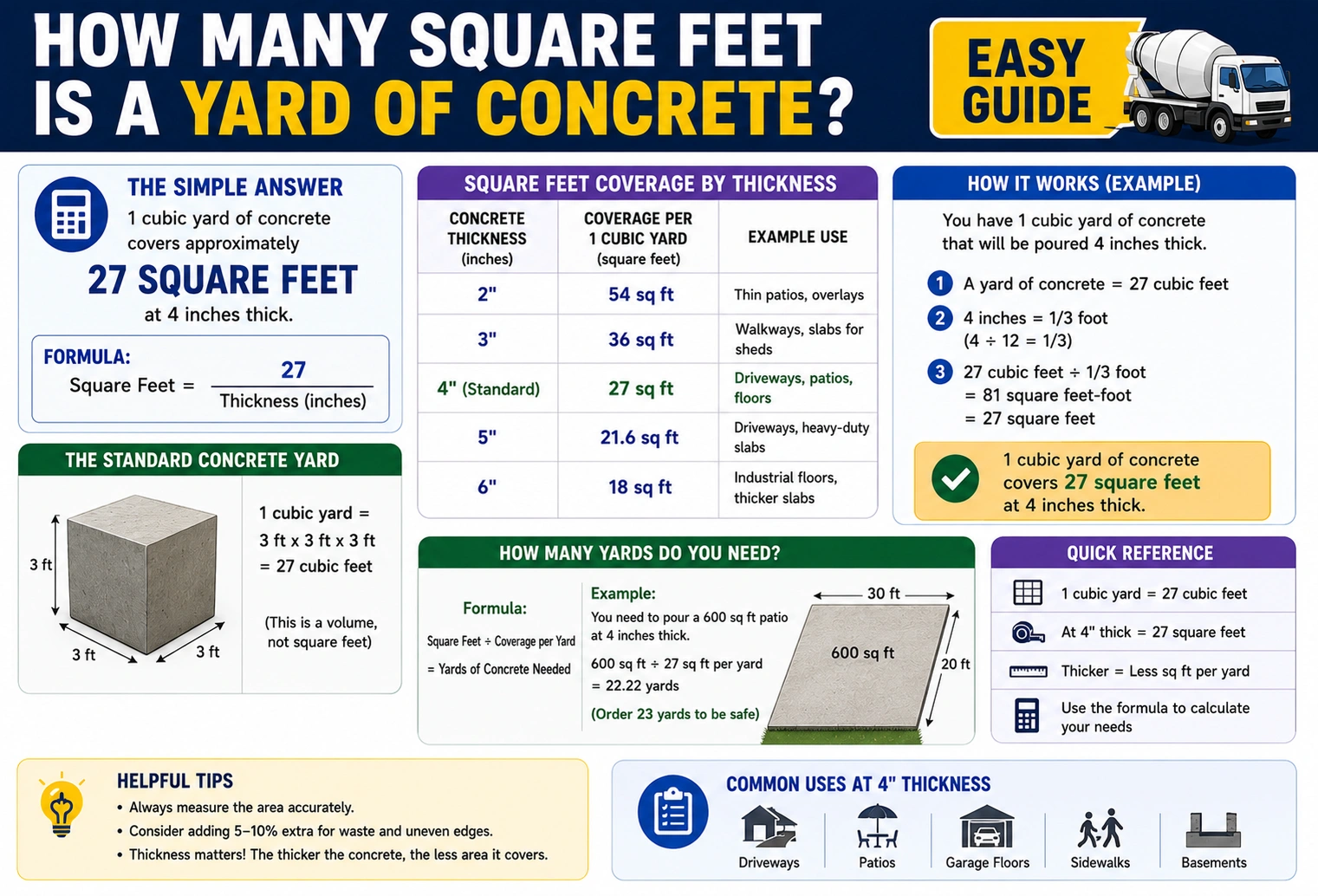
The answer depends on how thick the concrete slab will be. A cubic yard measures volume, while square feet measure area. Because of this, the coverage changes as the slab gets thicker or thinner.
For example, one cubic yard of concrete covers approximately 81 square feet at a thickness of 4 inches, which is the standard thickness for many residential slabs.
This guide explains how to calculate concrete coverage, provides easy-to-use charts, and shares practical examples to help you estimate your project accurately.
Quick Answer
One cubic yard of concrete equals 27 cubic feet.
The number of square feet it covers depends on slab thickness.
| Slab Thickness | Coverage Per Cubic Yard |
|---|---|
| 2 inches | 162 sq ft |
| 3 inches | 108 sq ft |
| 4 inches | 81 sq ft |
| 5 inches | 65 sq ft |
| 6 inches | 54 sq ft |
For most patios, sidewalks, and driveways poured 4 inches thick, 1 cubic yard covers about 81 square feet.
What Is a Yard of Concrete?
A yard of concrete refers to one cubic yard, which is a unit of volume.
One cubic yard equals:
- 27 cubic feet
- 729 cubic inches
- 0.765 cubic meters
Concrete is sold by volume because projects require different slab thicknesses.
How Concrete Coverage Is Calculated
To determine how many square feet a cubic yard covers, you need two pieces of information:
- The volume of concrete (1 cubic yard = 27 cubic feet)
- The thickness of the slab
The Formula
Use this formula:
Square Feet = Cubic Feet ÷ Thickness (in feet)
Since one cubic yard equals 27 cubic feet, the calculation becomes:
Coverage = 27 ÷ Thickness (feet)
Why Thickness Matters
The thicker the slab, the fewer square feet one yard of concrete can cover.
For example:
- Thin sidewalks require less concrete per square foot.
- Heavy-duty driveways need thicker slabs, reducing the total coverage.
Square Feet Covered by One Yard of Concrete
Here are the most common slab thicknesses.
2-Inch Slab
Thickness in feet:
2 ÷ 12 = 0.167 feet
27 ÷ 0.167 ≈ 162 square feet
3-Inch Slab
Thickness:
0.25 feet
27 ÷ 0.25 = 108 square feet
4-Inch Slab
Thickness:
0.333 feet
27 ÷ 0.333 ≈ 81 square feet
This is the standard estimate for:
- Patios
- Sidewalks
- Residential slabs
5-Inch Slab
Coverage:
Approximately 65 square feet
Often used for:
- Light vehicle parking
- Reinforced slabs
6-Inch Slab
Coverage:
Approximately 54 square feet
Typical applications include:
- Heavy-duty driveways
- Garage floors
- Commercial projects
Concrete Coverage Chart by Thickness
| Thickness | Coverage per Cubic Yard |
|---|---|
| 2 inches | 162 sq ft |
| 3 inches | 108 sq ft |
| 4 inches | 81 sq ft |
| 5 inches | 65 sq ft |
| 6 inches | 54 sq ft |
| 8 inches | 40.5 sq ft |
| 12 inches | 27 sq ft |
This chart makes it easy to estimate concrete needs for different projects.
Examples of Concrete Calculations
Example 1: Patio
Patio size:
18 × 18 feet
Area:
324 square feet
Thickness:
4 inches
Coverage per yard:
81 square feet
Concrete needed:
324 ÷ 81 = 4 cubic yards
Example 2: Sidewalk
Dimensions:
4 × 30 feet
Area:
120 square feet
Thickness:
4 inches
Concrete required:
120 ÷ 81 = 1.48 cubic yards
Round up to 1.5 cubic yards, plus extra for waste.
Example 3: Driveway
Dimensions:
20 × 20 feet
Area:
400 square feet
Thickness:
6 inches
Coverage:
54 square feet per yard
Concrete required:
400 ÷ 54 ≈ 7.4 cubic yards
How to Estimate Concrete for Your Project
Follow these simple steps.
Step 1
Measure:
- Length
- Width
Multiply to find square footage.
Step 2
Determine slab thickness.
Common choices include:
- 4 inches for patios
- 4–5 inches for sidewalks
- 5–6 inches for driveways
Step 3
Use the coverage chart or divide the total area by the coverage per cubic yard.
Step 4
Add 5–10% extra for waste, uneven ground, or over-excavation.
Common Mistakes When Ordering Concrete
Confusing Cubic Yards with Square Feet
Concrete is ordered by volume, not area.
Forgetting Thickness
Two projects with the same square footage may require different amounts of concrete if the slab thickness differs.
Not Ordering Extra
Ordering exactly the calculated amount may leave you short if there are spills or uneven grading.
Using Incorrect Measurements
Always measure carefully before placing an order.
Practical Applications
Knowing how much one yard of concrete covers is useful for:
- Driveways
- Sidewalks
- Patios
- Garage floors
- Shed foundations
- Basketball courts
- Concrete pads
- Walkways
Accurate estimates help reduce waste and avoid costly delivery delays.
Expert Tips
Use a Concrete Calculator
Online calculators can quickly estimate cubic yards based on project dimensions.
Round Up
Concrete suppliers typically recommend ordering slightly more than your calculated requirement.
Consider Reinforcement
Thicker slabs may require rebar or wire mesh for added strength.
Plan for Waste
Adding 5–10% extra concrete is a common industry practice.
9. FAQs
How many square feet does one yard of concrete cover?
It depends on the slab thickness. At 4 inches thick, one cubic yard covers about 81 square feet.
How many cubic feet are in one yard of concrete?
One cubic yard contains 27 cubic feet.
How much concrete do I need for 100 square feet?
At a thickness of 4 inches, you’ll need approximately 1.25 cubic yards of concrete.
Why does slab thickness affect coverage?
Thicker slabs use more concrete per square foot, reducing the total area one cubic yard can cover.
Should I order extra concrete?
Yes. Most contractors recommend ordering 5–10% extra to account for waste and uneven surfaces.
10. Conclusion
If you’re wondering how many square feet is a yard of concrete, the answer depends entirely on the thickness of the slab. A cubic yard of concrete covers about 81 square feet at 4 inches thick, 108 square feet at 3 inches, and 54 square feet at 6 inches. Understanding this relationship between volume and area is essential for accurately estimating concrete for patios, driveways, sidewalks, and foundations. By measuring your project carefully, selecting the correct slab thickness, and ordering a little extra for waste, you can complete your concrete project efficiently while avoiding unnecessary costs or material shortages.
Discover More Articles
How Many Feet Is 500 Yards? Exact Yard to Feet Conversion
How Many Square Feet in a Linear Foot? Easy Conversion Guide