
If you’ve ever looked at a building and wondered how many stories is 40 feet, you’re not alone. Building heights are often described in feet, while people tend to visualize structures in terms of stories or floors.
Whether you’re evaluating a property, planning a construction project, checking zoning restrictions, or simply curious, understanding how feet convert into stories can be extremely useful.
The short answer is:
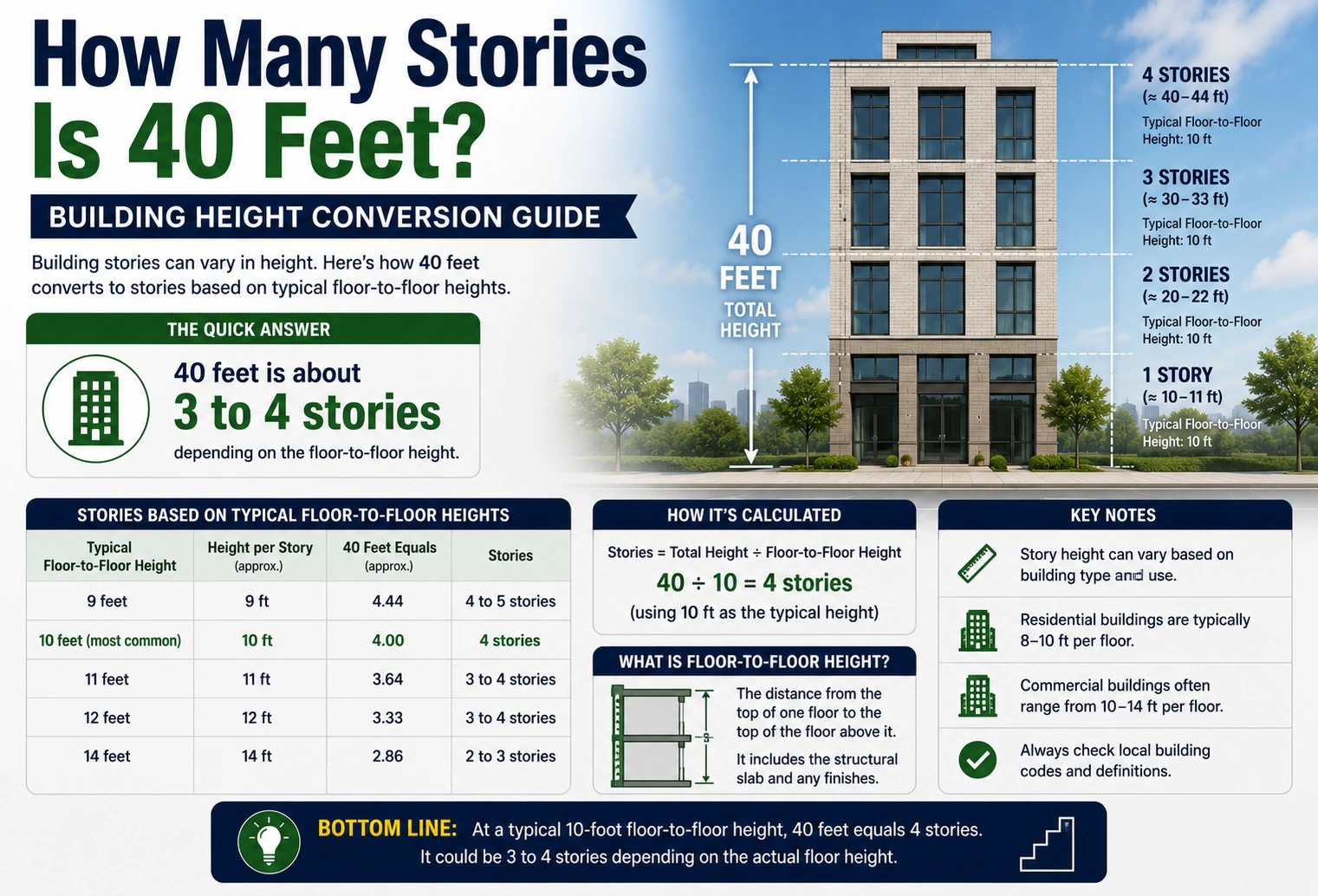
40 feet is typically about 3 to 4 stories tall.
However, the exact number depends on the type of building, ceiling heights, floor thickness, and architectural design.
In this guide, we’ll break down story-height standards, explain conversion methods, and show real-world examples to help you understand what a 40-foot building actually looks like.
Quick Answer
How Many Stories Is 40 Feet?
Using common building standards:
- Residential buildings: About 4 stories
- Commercial buildings: About 3 stories
General estimate:
40 feet ≈ 3–4 stories
Most people use:
10 feet per story for residential buildings.
Calculation:
40 ÷ 10 = 4 stories
Understanding Story Height
Before converting feet into stories, it helps to understand what a story actually means.
What Is a Story?
A story (or storey) is one occupied level within a building.
Examples include:
- Ground floor
- Second floor
- Third floor
Each level counts as one story regardless of the building’s total height.
Why Story Heights Vary
Not all buildings are constructed the same way.
Story heights depend on:
- Ceiling height
- Structural components
- HVAC systems
- Building codes
- Roof design
This is why a three-story office building may be taller than a three-story house.
How Many Stories Is 40 Feet?
The answer depends on the type of building.
Residential Buildings
Most homes and apartment buildings use:
- 8–9 foot ceilings
- 1–2 feet for floor structure
Average floor-to-floor height:
10 feet
Calculation:
40 ÷ 10 = 4 stories
Result:
40 feet is approximately 4 residential stories.
Commercial Buildings
Commercial buildings often feature:
- Higher ceilings
- Larger mechanical systems
- More structural space
Average floor height:
12–15 feet
Calculations:
40 ÷ 12 = 3.3 stories
40 ÷ 15 = 2.7 stories
Result:
40 feet is approximately 3 commercial stories.
Story Height Conversion Chart
The following chart shows common story estimates.
| Height (Feet) | Approximate Stories |
|---|---|
| 10 ft | 1 story |
| 20 ft | 2 stories |
| 30 ft | 3 stories |
| 40 ft | 3–4 stories |
| 50 ft | 4–5 stories |
| 60 ft | 5–6 stories |
| 80 ft | 7–8 stories |
| 100 ft | 8–10 stories |
These figures are estimates and may vary by building type.
What Does a 40-Foot Building Look Like?
Visualizing 40 feet can be difficult.
Here are some real-world comparisons.
Four-Story Apartment Building
Many residential apartment buildings with four floors stand close to:
40 feet tall
Three-Story Office Building
A commercial office structure with taller ceilings may reach:
40 feet
Even with only three stories.
Large Townhouse
Some luxury townhouses and urban row houses approach:
35–45 feet in height
Mature Trees
Many mature trees grow to:
40 feet tall
Providing another useful comparison.
Factors That Affect Story Height
Several design elements influence the relationship between feet and stories.
Ceiling Height
Residential ceilings commonly range from:
- 8 feet
- 9 feet
- 10 feet
Luxury homes may have:
- 12-foot ceilings
Higher ceilings increase story height.
Floor Thickness
Each story includes:
- Joists
- Concrete slabs
- Insulation
- Electrical systems
- Plumbing
These components add extra vertical space.
Roof Design
Roof structures can add several feet beyond the top story.
Examples include:
- Gable roofs
- Hip roofs
- Mansard roofs
Building Type
Commercial buildings generally require more vertical space than residential structures.
Residential vs Commercial Story Estimates
The same 40-foot height can represent different numbers of stories.
| Building Type | Average Height per Story | Stories in 40 Feet |
|---|---|---|
| Residential Home | 10 ft | 4 stories |
| Apartment Building | 10–12 ft | 3–4 stories |
| Office Building | 12–15 ft | 3 stories |
| Hotel | 11–14 ft | 3–4 stories |
| Retail Building | 12–16 ft | 2–3 stories |
This variation explains why building height estimates are not always exact.
Real-World Examples of 40-Foot Structures
Fire Department Ladder Reach
Many basic fire ladders can access buildings around:
35–40 feet tall
Utility Poles
Some utility poles measure:
40 feet in height
Small Office Buildings
Many suburban office buildings stand approximately:
40 feet tall
Residential Condominiums
Four-story condominium buildings often range from:
38–45 feet tall
Common Mistakes When Estimating Stories
Assuming Every Story Is 10 Feet
While common for homes, commercial buildings often exceed this height.
Ignoring Roof Height
Roof structures can add significant height beyond the occupied floors.
Confusing Ceiling Height With Story Height
The total story height includes:
- Ceiling
- Floor structure
- Mechanical space
Forgetting Building Codes
Local building codes may require additional height allowances.
How to Convert Feet to Stories
A simple method can help estimate story counts.
Residential Formula
Stories = Height ÷ 10
For 40 feet:
40 ÷ 10 = 4 stories
Commercial Formula
Stories = Height ÷ 12–15
For 40 feet:
40 ÷ 12 = 3.3 stories
40 ÷ 15 = 2.7 stories
Result:
Approximately 3 stories
Universal Rule
Many professionals use:
11 feet per story
Calculation:
40 ÷ 11 = 3.6 stories
This supports the estimate of:
3–4 stories
Why Knowing Story Height Matters
Understanding building height conversions helps with:
- Construction planning
- Zoning compliance
- Property evaluations
- Architectural design
- Drone operations
- Fire safety planning
It also provides a practical way to visualize structures from height measurements alone.
9. FAQs
1. How many stories is 40 feet tall?
Most buildings that are 40 feet tall are approximately 3 to 4 stories.
2. Is 40 feet considered a 4-story building?
Yes. In residential construction, 40 feet is commonly equivalent to about 4 stories.
3. How many commercial stories is 40 feet?
Typically 3 commercial stories, depending on ceiling heights and building design.
4. How many feet is one story?
One story is generally 10 to 12 feet tall, though commercial buildings may be taller.
5. Can a 3-story building be 40 feet tall?
Yes. Many office buildings and commercial structures reach 40 feet with only three stories.
10. Conclusion
If you’re wondering how many stories is 40 feet, the most accurate answer is approximately 3 to 4 stories, depending on the building type. Residential structures often average about 10 feet per story, making 40 feet equal to roughly 4 stories, while commercial buildings typically use 12–15 feet per story, making 40 feet closer to 3 stories.
Understanding these conversions can help with construction planning, real estate evaluations, zoning requirements, and architectural projects. As a general rule, when estimating building height, 40 feet is best viewed as a 3–4 story structure.
Discover More Articles
How Many Feet Is 100 Square Feet? Understanding the Difference