
If you’ve ever looked at a building and wondered how many stories is 90 feet, you’re not alone. Architects, real estate professionals, contractors, and curious homeowners often need to convert a building’s height into an estimated number of floors.
While there isn’t a single exact answer, most buildings follow standard floor-height guidelines that make it possible to estimate the number of stories from a given height.
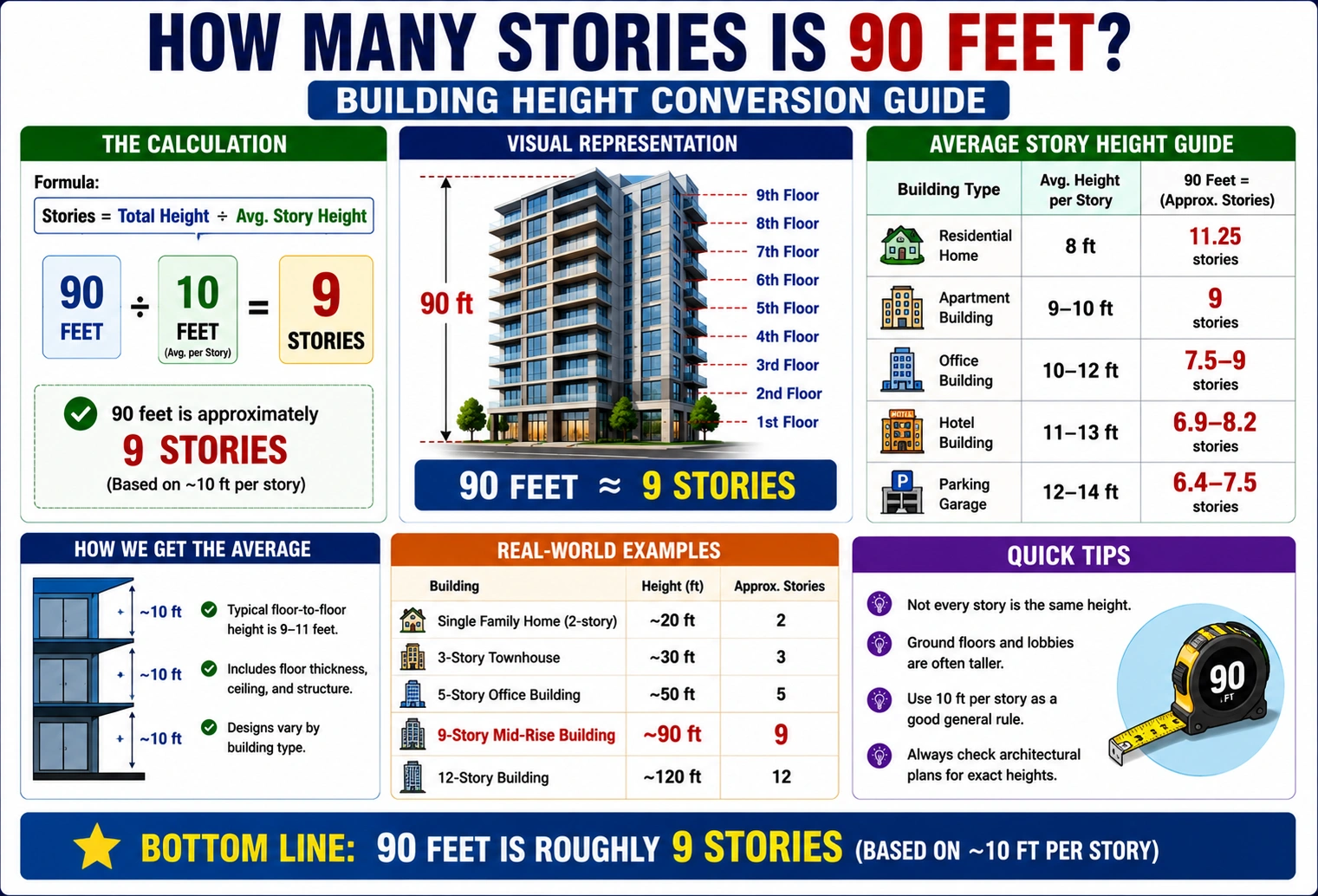
For a 90-foot-tall building, the answer usually falls between 8 and 10 stories, depending on the building type.
Quick Answer
A 90-foot building is typically about 8 to 10 stories tall.
Here’s a general rule:
| Building Type | Average Story Height | Stories in 90 Feet |
|---|---|---|
| Residential | 9–10 feet | 9–10 stories |
| Apartment Building | 10–12 feet | 8–9 stories |
| Commercial Building | 12–15 feet | 6–8 stories |
| Office Building | 13–15 feet | 6–7 stories |
For most residential structures:
90 feet is approximately 9 stories.
Understanding Building Story Heights
To determine how many stories fit into 90 feet, you first need to understand what a “story” means.
A story is the vertical section of a building between one floor and the next.
The height of a story includes:
- Floor structure
- Ceiling height
- Mechanical systems
- Utility space
- Structural components
Because these elements vary by building type, story heights are not always the same.
How Many Stories Is 90 Feet?
The number of stories depends on the average floor height.
Basic Formula
Stories = Building Height ÷ Average Story Height
For a 90-foot building:
90 ÷ 10 = 9 stories
This provides a useful estimate.
Residential Buildings
Most homes and apartment buildings have floor heights between:
9 and 10 feet
Using these measurements:
| Story Height | Estimated Stories |
|---|---|
| 9 Feet | 10 Stories |
| 10 Feet | 9 Stories |
Therefore:
90 feet is roughly 9–10 residential stories.
Apartment Buildings
Modern apartment buildings often average:
10–12 feet per floor
Calculation:
90 ÷ 11 = 8.2
Result:
About 8–9 apartment stories.
Commercial Buildings
Commercial properties usually require more vertical space.
This accommodates:
- HVAC systems
- Lighting
- Utility lines
- Larger ceilings
Average floor height:
12–15 feet
Calculations:
90 ÷ 12 = 7.5
90 ÷ 15 = 6
Result:
6–8 commercial stories.
Office Buildings
Modern office buildings often feature:
- Raised floors
- Suspended ceilings
- Mechanical systems
Typical floor heights:
13–15 feet
Calculations:
90 ÷ 13 = 6.9
90 ÷ 15 = 6
Result:
Approximately 6–7 office stories.
Average Height of One Story
Many people use a simple rule:
One Story = 10 Feet
This guideline works well for quick estimates.
However, actual heights vary.
| Building Type | Average Story Height |
|---|---|
| House | 8–10 ft |
| Apartment | 10–12 ft |
| Hotel | 10–12 ft |
| Office | 13–15 ft |
| Retail Store | 14–20 ft |
Using the 10-foot rule:
90 feet ≈ 9 stories
Factors That Affect Story Height
Several factors influence how many stories fit into 90 feet.
Ceiling Height
Luxury buildings often have higher ceilings.
Mechanical Systems
Air ducts and utilities require additional space.
Structural Design
Some buildings use thicker floor assemblies.
Ground-Level Floors
Lobby levels are often taller than upper floors.
Building Codes
Local regulations can influence floor-to-floor dimensions.
Real-World Examples of 90-Foot Buildings
Visual comparisons help put 90 feet into perspective.
Mature Trees
Many large trees reach:
80–100 feet tall
making them similar in height.
Eight-Story Apartment Building
Many urban apartment buildings stand around:
85–95 feet
depending on design.
Mid-Rise Hotels
Some hotels fall within the:
90-foot range
especially those with 7–9 floors.
Water Towers
Many municipal water towers reach heights close to:
90 feet.
Story Height Comparison Chart
| Building Height | Approximate Stories |
|---|---|
| 20 Feet | 2 Stories |
| 30 Feet | 3 Stories |
| 40 Feet | 4 Stories |
| 50 Feet | 5 Stories |
| 60 Feet | 6 Stories |
| 70 Feet | 7 Stories |
| 80 Feet | 8 Stories |
| 90 Feet | 8–10 Stories |
| 100 Feet | 9–11 Stories |
This chart provides quick estimates for common building heights.
Why Story Estimates Vary
Many people expect an exact answer.
However, building stories are not standardized worldwide.
For example:
Residential Tower
90 feet could equal:
10 stories
Office Building
90 feet could equal:
6 stories
Mixed-Use Building
90 feet might contain:
7–8 stories
The design determines the final count.
Common Mistakes When Converting Feet to Stories
Assuming Every Story Is 10 Feet
While useful, it’s only an estimate.
Ignoring Mechanical Floors
These can increase total height.
Forgetting Roof Structures
Penthouses and rooftop equipment add height.
Using Residential Standards for Commercial Buildings
Commercial floors are typically taller.
Practical Example
Suppose a city zoning code allows buildings up to:
90 feet tall
A developer planning apartments with:
10-foot floor heights
could build:
90 ÷ 10 = 9 stories
The same height used for office space may allow only:
6–7 stories.
Expert Tips for Estimating Stories
Use 10 Feet Per Story for Quick Estimates
This works well for residential buildings.
Verify Building Type
Different uses require different floor heights.
Check Local Building Codes
Height limits vary by location.
Account for Mechanical Space
Especially in larger buildings.
9. FAQs
How many stories is 90 feet exactly?
There is no exact answer, but 90 feet is typically 8–10 stories depending on building type.
Is 90 feet considered a high-rise?
Generally, no. Most 90-foot buildings are considered mid-rise structures.
How many residential stories fit into 90 feet?
Usually 9 to 10 stories.
How many office floors fit into 90 feet?
Typically 6 to 7 office stories.
Is one story always 10 feet?
No. Story heights vary depending on building design and use.
10. Conclusion
If you’re wondering how many stories is 90 feet, the most accurate estimate is 8 to 10 stories, with 9 stories being a common approximation for residential buildings. The exact number depends on floor-to-floor height, ceiling design, building use, and mechanical systems. While residential buildings often average around 10 feet per story, commercial and office structures usually require more space per floor. Understanding these differences makes it easier to estimate building height and compare structures in real-world situations.
Discover More Articles
How Many Feet on a Mile? Exact Conversion Guide