
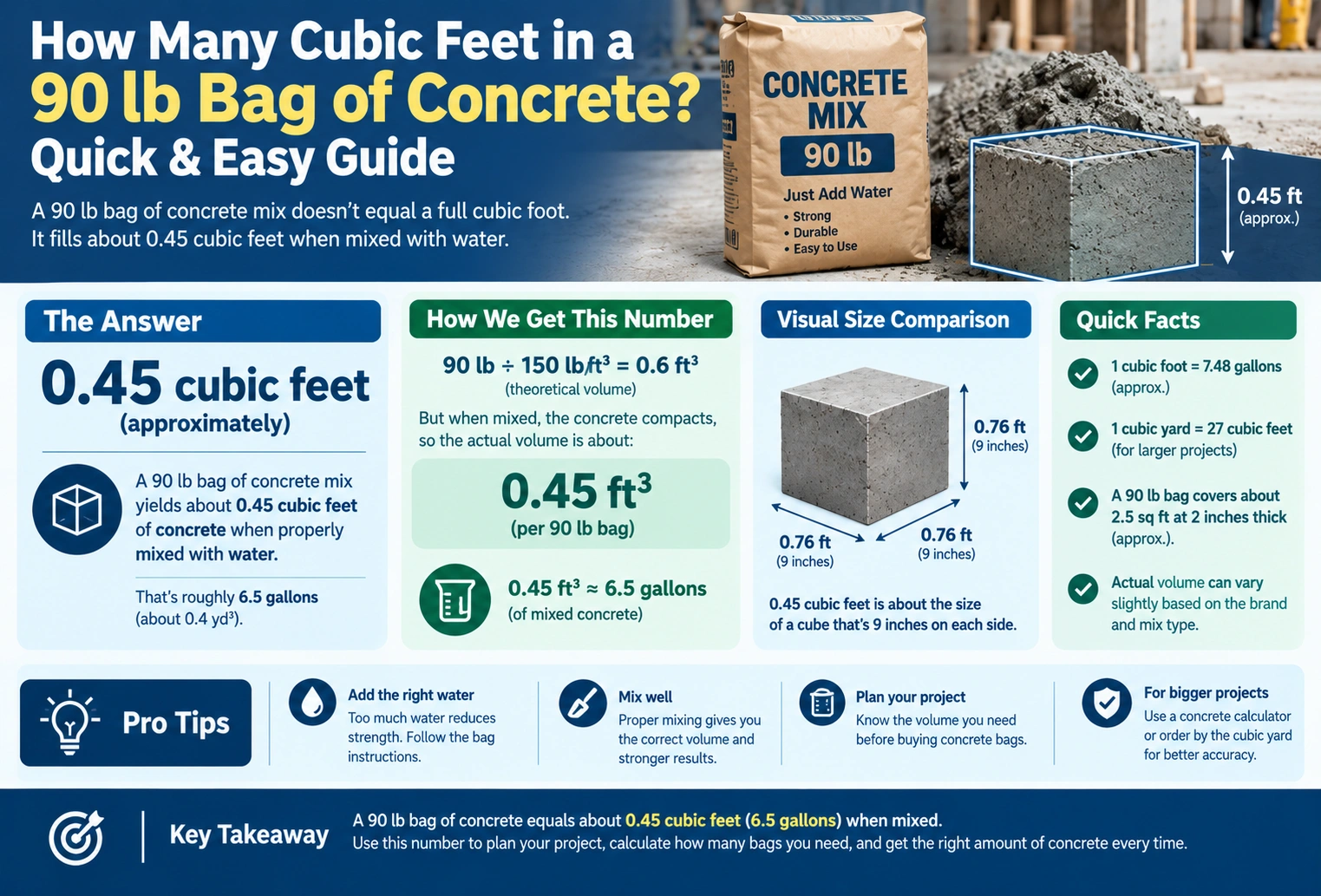
A typical 90 lb bag of concrete mix yields about 0.67 cubic feet of concrete when properly mixed with water.
That means you can expect approximately two-thirds of a cubic foot of finished concrete from one 90-pound bag. Actual yield can vary slightly by manufacturer and product, so always check the yield printed on the bag.
| Concrete Bag Size | Typical Yield |
|---|---|
| 40 lb | About 0.30 cu ft |
| 50 lb | About 0.375 cu ft |
| 60 lb | About 0.45 cu ft |
| 80 lb | About 0.60 cu ft |
| 90 lb | About 0.67 cu ft |
| 100 lb | About 0.75 cu ft |
How Many Cubic Feet Does a 90 lb Bag of Concrete Make?
A standard 90 lb bag of concrete mix typically produces approximately:
0.67 cubic feet of concrete
The word “yield” is important here. A 90 lb bag does not mean the dry contents occupy 0.67 cubic feet. Instead, the manufacturer calculates the amount of finished concrete produced after the dry mix is combined with the recommended amount of water.
For estimating purposes:
1 bag of 90 lb concrete ≈ 0.67 cubic feet
If you are planning a concrete project, use the product’s stated yield whenever possible because different mixes can have slightly different yields.
How Do You Calculate Cubic Feet From a 90 lb Bag?
The basic calculation is straightforward when you know the yield.
If one 90 lb bag produces approximately 0.67 cubic feet:
1 bag × 0.67 cu ft = 0.67 cu ft
For multiple bags:
Number of bags × 0.67 = Total cubic feet
For example, 5 bags would produce approximately:
5 × 0.67 = 3.35 cubic feet
| Number of 90 lb Bags | Approximate Concrete Yield |
|---|---|
| 1 | 0.67 cu ft |
| 2 | 1.34 cu ft |
| 3 | 2.01 cu ft |
| 4 | 2.68 cu ft |
| 5 | 3.35 cu ft |
| 10 | 6.70 cu ft |
| 15 | 10.05 cu ft |
| 20 | 13.40 cu ft |
These are estimates based on a 0.67 cubic-foot yield per bag.
How Many 90 lb Bags of Concrete Are in a Cubic Yard?
One cubic yard contains:
27 cubic feet
If one 90 lb bag produces approximately 0.67 cubic feet:
27 ÷ 0.67 ≈ 40.3 bags
So you would need approximately 41 bags of 90 lb concrete mix to produce one cubic yard of finished concrete.
However, because you cannot purchase a fraction of a bag and because job-site conditions can cause waste, ordering 41 bags exactly may not provide enough material for a project requiring a full cubic yard.
| Finished Concrete Needed | Approx. 90 lb Bags |
|---|---|
| 1 cu ft | 2 bags |
| 2 cu ft | 3 bags |
| 5 cu ft | 8 bags |
| 10 cu ft | 15 bags |
| 20 cu ft | 30 bags |
| 27 cu ft (1 yd³) | About 41 bags |
How Many Cubic Feet Are in 10 Bags of 90 lb Concrete?
Using a yield of 0.67 cubic feet per bag:
10 × 0.67 = 6.7 cubic feet
Therefore:
10 bags ≈ 6.7 cubic feet of finished concrete
This is equivalent to approximately:
6.7 ÷ 27 ≈ 0.248 cubic yards
So 10 bags provide roughly one-quarter of a cubic yard of concrete.
How Many Bags Do You Need for 1 Cubic Foot?
If one bag produces 0.67 cubic feet:
1 ÷ 0.67 ≈ 1.49 bags
Since you cannot use 0.49 of a bag without measuring and storing the remaining mix properly, you would generally need 2 bags to have enough material for a project requiring about 1 cubic foot.
Two bags theoretically yield:
2 × 0.67 = 1.34 cubic feet
This also provides a small amount of extra material.
90 lb Concrete Bags Compared With Other Bag Sizes
Bag size affects how much finished concrete each bag can produce.
| Bag Size | Approx. Yield | Bags for 1 cu yd |
|---|---|---|
| 40 lb | 0.30 cu ft | 90 bags |
| 50 lb | 0.375 cu ft | 72 bags |
| 60 lb | 0.45 cu ft | 60 bags |
| 80 lb | 0.60 cu ft | 45 bags |
| 90 lb | 0.67 cu ft | About 41 bags |
| 100 lb | 0.75 cu ft | 36 bags |
These values are approximate because concrete yields vary among products.
How Much Area Does One 90 lb Bag Cover?
A bag’s coverage depends on the thickness of the concrete.
A 90 lb bag yielding 0.67 cubic feet can cover different surface areas depending on how thick the slab is.
Use:
Area = Volume ÷ Thickness
The thickness must be expressed in feet.
For example, a 4-inch slab has a thickness of:
4 ÷ 12 = 0.333 feet
Then:
0.67 ÷ 0.333 ≈ 2.01 square feet
So one 90 lb bag could cover approximately 2 square feet at 4 inches thick.
| Concrete Thickness | Approx. Coverage per 90 lb Bag |
|---|---|
| 2 inches | ~4.0 sq ft |
| 3 inches | ~2.7 sq ft |
| 4 inches | ~2.0 sq ft |
| 5 inches | ~1.6 sq ft |
| 6 inches | ~1.3 sq ft |
| 8 inches | ~1.0 sq ft |
These figures assume a 0.67 cubic-foot yield and do not include additional material for waste.
How Many 90 lb Bags Do You Need for a 4 × 4 Slab?
Suppose you want to make a 4 × 4 foot slab that is 4 inches thick.
First calculate the area:
4 × 4 = 16 square feet
Convert 4 inches to feet:
4 ÷ 12 = 0.333 feet
Now calculate volume:
16 × 0.333 ≈ 5.33 cubic feet
If each bag produces approximately 0.67 cubic feet:
5.33 ÷ 0.67 ≈ 7.96 bags
You would therefore need approximately 8 bags, before allowing for waste or variations in yield.
| Measurement | Value |
|---|---|
| Slab length | 4 ft |
| Slab width | 4 ft |
| Slab thickness | 4 in |
| Required volume | ~5.33 cu ft |
| Yield per bag | ~0.67 cu ft |
| Bags required | ~8 bags |
For real projects, purchasing a little extra is generally wise.
How Many 90 lb Bags Do You Need for a 10 × 10 Slab?
Consider a 10 × 10 foot slab that is 4 inches thick.
First:
10 × 10 = 100 square feet
Then convert thickness:
4 inches ÷ 12 = 0.333 feet
Volume:
100 × 0.333 ≈ 33.3 cubic feet
Now divide by the approximate yield:
33.3 ÷ 0.67 ≈ 49.7 bags
So you would need approximately 50 bags of 90 lb concrete mix.
| Slab Size | Thickness | Approx. Bags |
|---|---|---|
| 4 × 4 ft | 4 in | 8 |
| 5 × 5 ft | 4 in | 13 |
| 6 × 6 ft | 4 in | 18 |
| 8 × 8 ft | 4 in | 32 |
| 10 × 10 ft | 4 in | 50 |
These numbers are estimates based on a 0.67 cu ft yield.
How to Calculate How Many Bags You Need
You can calculate the number of 90 lb bags required for almost any rectangular concrete project using three steps.
Step 1: Calculate Square Footage
Multiply length by width.
Length × Width = Area
For example:
8 × 10 = 80 sq ft
Step 2: Convert Thickness to Feet
If your slab is 4 inches thick:
4 ÷ 12 = 0.333 ft
Step 3: Calculate Cubic Feet
Multiply area by thickness:
80 × 0.333 = 26.64 cubic feet
Then divide by the bag yield:
26.64 ÷ 0.67 ≈ 39.8 bags
So you would need approximately 40 bags before accounting for waste.
Concrete Bag Calculator Formula
For a rectangular slab, use:
Cubic feet = Length × Width × Thickness in feet
Then:
Number of bags = Cubic feet required ÷ Yield per bag
For a 90 lb bag with an assumed 0.67 cubic-foot yield:
Number of bags = Cubic feet required ÷ 0.67
This formula works for sidewalks, pads, small slabs, steps, posts, footings, and other rectangular projects.
Why Concrete Yield Can Vary
Not every 90 lb bag produces exactly the same amount of concrete.
Several factors can affect the final yield.
Product Formulation
Different manufacturers use different aggregate sizes and mix designs.
Water Amount
Adding the recommended amount of water is important. Too much or too little water can affect the concrete’s properties and workability.
Mixing and Handling
Material left in a mixer, wheelbarrow, bucket, or tools can contribute to small losses.
Uneven Forms
If the excavation or form is not perfectly level, you may use more concrete than the theoretical calculation suggests.
Waste
Spillage and leftover material can increase the number of bags needed.
For these reasons, use the manufacturer’s published yield for the exact product whenever possible.
Should You Buy Extra Bags?
For small concrete projects, buying a little extra material can help prevent delays.
If your calculation requires exactly 10 bags, for example, you may want to have an additional bag available rather than discovering that you are slightly short during placement.
| Calculated Requirement | Practical Approach |
|---|---|
| 1–5 bags | Consider 1 extra bag |
| 6–20 bags | Consider a small reserve |
| 20+ bags | Calculate carefully and follow product yield |
| Large slab | Compare bagged concrete with ready-mix delivery |
For large projects, bagged concrete may become labor-intensive and expensive compared with ordering ready-mix concrete.
90 lb Bags vs. Ready-Mix Concrete
The best option depends on the size of your project.
| Factor | 90 lb Bags | Ready-Mix Delivery |
|---|---|---|
| Small projects | Excellent | Often unnecessary |
| Large slabs | Labor-intensive | More convenient |
| Mixing | Done on site | Mixed commercially |
| Labor | Higher | Lower on site |
| Equipment | Mixer or mixing tools | Truck delivery |
| Waste risk | Can be higher | Easier to order by volume |
| Convenience | Good for small jobs | Better for large jobs |
For small repairs, posts, steps, pads, and similar jobs, bags can be convenient. For larger slabs requiring many bags, ready-mix delivery may be more practical.
Common Mistakes When Calculating Concrete
Mistake 1: Confusing Pounds With Cubic Feet
A bag’s weight does not directly tell you its volume of finished concrete.
The yield is what you need for concrete-volume calculations.
Mistake 2: Forgetting to Convert Inches to Feet
If a slab is 4 inches thick, do not use 4 as the thickness in a cubic-foot formula.
Use:
4 ÷ 12 = 0.333 ft
Mistake 3: Assuming Every 90 lb Bag Has the Same Yield
Different products can have different published yields.
Mistake 4: Ordering the Exact Minimum
Small amounts of waste can leave you short.
Mistake 5: Confusing Cubic Feet With Square Feet
Square feet measure surface area. Cubic feet measure volume.
A concrete slab needs both its area and thickness to calculate cubic feet.
Frequently Asked Questions
1. How many cubic feet are in a 90 lb bag of concrete?
A typical 90 lb bag of concrete mix yields approximately 0.67 cubic feet of finished concrete. Check the specific product label for the manufacturer’s exact yield.
2. How many 90 lb bags of concrete make 1 cubic yard?
One cubic yard contains 27 cubic feet. At approximately 0.67 cubic feet per bag, you need about 41 bags of 90 lb concrete mix.
3. How many square feet does a 90 lb bag of concrete cover?
Coverage depends on thickness. At approximately 4 inches thick, one 90 lb bag yielding 0.67 cubic feet covers about 2 square feet.
4. How many 90 lb bags do I need for a 10 × 10 slab?
For a 10 × 10 foot slab that is 4 inches thick, you need approximately 50 bags if each bag yields 0.67 cubic feet. Add an appropriate allowance for waste.
5. How do I calculate how many bags of concrete I need?
Calculate the project’s cubic feet by multiplying length × width × thickness in feet. Then divide the result by the concrete bag’s stated yield.
Conclusion
A typical 90 lb bag of concrete produces about 0.67 cubic feet of finished concrete. That makes it useful for estimating how many bags you’ll need for slabs, walkways, posts, footings, steps, and other small construction projects.
The basic formula is:
Number of bags = Required cubic feet ÷ 0.67
For the most accurate estimate, always check the yield printed on the specific 90 lb concrete bag you plan to purchase. Product formulations vary, and allowing some extra material can help account for waste and uneven forms.
Discover More Articles
How Many Square Feet Can a 2.5 Ton AC Cool?