
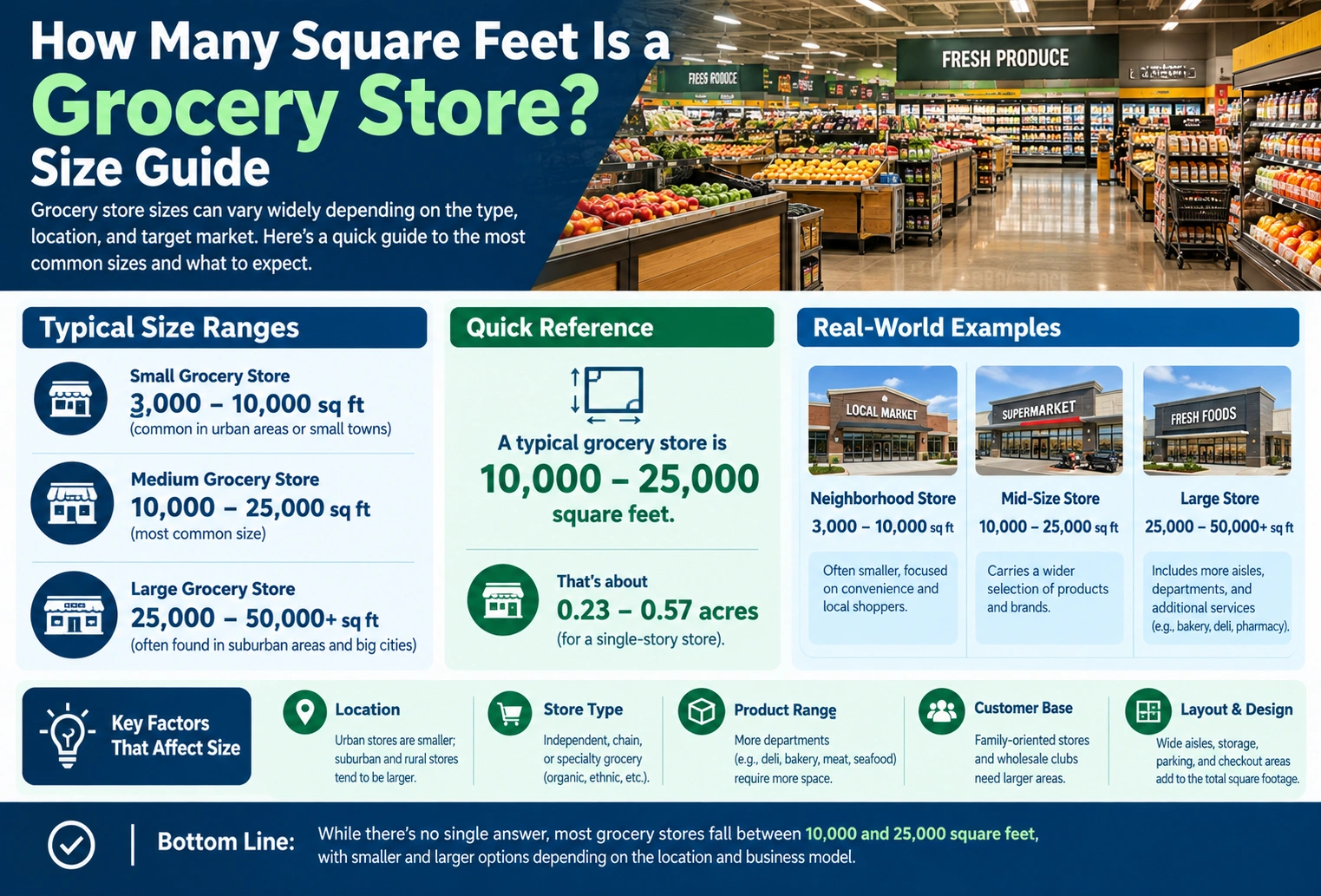
If you’re wondering how many square feet a grocery store is, there is no single standard size. Grocery stores range from small neighborhood markets occupying only a few thousand square feet to large supermarkets covering tens of thousands of square feet.
A typical full-service grocery store is often around 20,000 to 60,000 square feet, while smaller markets may be under 10,000 square feet and very large stores can exceed 100,000 square feet.
The exact size depends on the store’s product selection, location, customer base, parking requirements, storage needs, and business model.
Quick Answer
A typical grocery store is approximately 20,000–60,000 square feet.
| Grocery Store Type | Approximate Size |
|---|---|
| Small neighborhood market | 2,000–10,000 sq ft |
| Small grocery store | 10,000–20,000 sq ft |
| Typical supermarket | 20,000–60,000 sq ft |
| Large supermarket | 60,000–100,000 sq ft |
| Superstore / warehouse-style grocery | 100,000+ sq ft |
These are general size categories rather than strict industry standards. Individual stores can fall outside these ranges.
Typical Grocery Store Size
Grocery stores need considerably more space than the area customers see while shopping.
A store may need room for:
- Grocery aisles
- Produce
- Meat and seafood
- Dairy and frozen foods
- Bakery
- Deli
- Checkout lanes
- Customer service
- Refrigeration equipment
- Receiving areas
- Inventory storage
- Employee areas
- Offices
- Restrooms
Because of these requirements, the building’s total square footage can be substantially larger than the visible shopping floor.
| Area of Store | Examples |
|---|---|
| Sales floor | Grocery aisles, displays, produce |
| Fresh food departments | Meat, bakery, deli, seafood |
| Refrigerated areas | Dairy, frozen foods |
| Checkout | Registers and checkout lanes |
| Back-of-house | Receiving, storage, inventory |
| Employee space | Offices, break rooms, restrooms |
The balance between these areas varies from one grocery store to another.
Grocery Store Sizes by Type
Not every grocery business needs the same amount of space.
Small Neighborhood Markets
A small neighborhood grocery store may occupy approximately 2,000–10,000 square feet.
These stores typically carry a more limited selection and may focus on frequently purchased products, fresh food, beverages, household necessities, and convenience items.
| Feature | Small Grocery Store |
|---|---|
| Approx. size | 2,000–10,000 sq ft |
| Product selection | Limited to moderate |
| Number of aisles | Usually fewer |
| Fresh departments | Limited or specialized |
| Customer capacity | Lower |
| Typical location | Neighborhood or urban area |
A compact grocery store can serve a local community without requiring the large footprint of a traditional supermarket.
Mid-Size Grocery Stores
Stores in the 10,000–30,000-square-foot range can provide a broader selection while still remaining relatively compact.
They may have dedicated sections for produce, meat, dairy, frozen foods, bakery products, and household goods.
Full-Size Supermarkets
A conventional supermarket may occupy approximately 20,000–60,000 square feet.
These stores generally provide a much wider range of products and departments.
| Department | Typical Space Requirement |
|---|---|
| Produce | Moderate to large |
| Meat and seafood | Moderate |
| Dairy | Moderate |
| Frozen foods | Moderate |
| Bakery | Moderate |
| Deli/prepared foods | Moderate |
| Grocery aisles | Large portion of sales floor |
| Checkout | Multiple lanes |
| Storage/receiving | Significant back-of-house area |
The exact allocation depends on the store’s concept and product mix.
Large Supermarkets
Large supermarkets can occupy 60,000–100,000 square feet or more.
These stores may include extensive fresh-food departments, prepared meals, pharmacies, specialty foods, household products, seasonal merchandise, and other services.
What Determines Grocery Store Square Footage?
Several factors influence how large a grocery store needs to be.
Product Selection
A store selling thousands of different products requires more shelf and display space than a small convenience-focused market.
Customer Base
A grocery store serving a large population may require a larger sales floor to accommodate more shoppers.
Location
Land and construction costs can influence store size. Urban locations may favor smaller stores because commercial space is expensive and land is limited.
Suburban locations may provide enough land for larger stores and parking areas.
Business Model
A specialty market, discount grocery store, supermarket, and warehouse-style retailer may have very different space requirements.
Storage Requirements
Grocery stores need significant back-of-house space for inventory, deliveries, refrigeration, and receiving.
Additional Services
A store offering a bakery, pharmacy, deli, prepared meals, coffee shop, floral department, or other services may require additional square footage.
Grocery Store Floor Space Breakdown
A grocery store’s total square footage can be divided into customer-facing and non-customer-facing areas.
The exact proportions vary, but a simplified example might look like this:
| Store Area | Approximate Share of Total Space |
|---|---|
| Sales floor | 60–75% |
| Backroom/storage | 10–20% |
| Receiving | 5–10% |
| Offices/employee areas | 3–7% |
| Restrooms/service areas | 2–5% |
These percentages are planning examples rather than universal industry standards. Actual layouts can differ substantially.
For example, a 40,000-square-foot grocery store might allocate roughly 25,000–30,000 square feet to customer-facing sales areas, with the remainder supporting storage, receiving, offices, equipment, and other functions.
Small Grocery Store vs Supermarket
The difference between a small grocery store and a full-size supermarket can be significant.
| Factor | Small Grocery Store | Supermarket |
|---|---|---|
| Typical size | 2,000–10,000 sq ft | 20,000–60,000 sq ft |
| Product selection | Limited | Extensive |
| Grocery aisles | Fewer | Many |
| Fresh departments | Limited | Broad |
| Checkout lanes | Few | Multiple |
| Storage capacity | Limited | Larger |
| Customer volume | Lower | Higher |
| Additional services | Few | More common |
The larger footprint allows supermarkets to carry more products and provide more departments under one roof.
How Big Is a Large Grocery Store?
A large grocery store can exceed 60,000 square feet, with some very large grocery and superstore formats reaching 100,000 square feet or more.
At that size, the store begins to resemble a large retail building rather than a compact neighborhood market.
| Store Size | General Category |
|---|---|
| Under 5,000 sq ft | Very small market |
| 5,000–10,000 sq ft | Small market |
| 10,000–20,000 sq ft | Small-to-mid grocery |
| 20,000–40,000 sq ft | Mid-size supermarket |
| 40,000–60,000 sq ft | Large supermarket |
| 60,000–100,000 sq ft | Very large supermarket |
| 100,000+ sq ft | Superstore/large-format retail |
These categories are useful for visualization but should not be treated as universal definitions.
How Many Square Feet Does a Grocery Store Need?
If you’re planning a grocery business, the required square footage depends on the type of store you want to operate.
| Business Concept | Approximate Starting Space |
|---|---|
| Small neighborhood market | 2,000–5,000 sq ft |
| Local grocery store | 5,000–15,000 sq ft |
| Mid-size grocery | 15,000–30,000 sq ft |
| Full-service supermarket | 30,000–60,000 sq ft |
| Large supermarket | 60,000–100,000+ sq ft |
A smaller store can work well when the goal is convenience and a focused product selection. A larger store needs more inventory and customer traffic to justify its additional operating space.
The building itself is also only part of the property requirement. A grocery store may need substantial space outside the building for parking, delivery access, loading areas, landscaping, and traffic circulation.
Grocery Store Size Compared With Other Buildings
Comparing a grocery store with familiar buildings can make its square footage easier to visualize.
| Building or Space | Approximate Area |
|---|---|
| Small grocery market | 2,000–10,000 sq ft |
| Typical supermarket | 20,000–60,000 sq ft |
| Large supermarket | 60,000–100,000+ sq ft |
| Small house | 1,000–2,000 sq ft |
| Large house | 2,500–4,000+ sq ft |
| Small warehouse | 10,000–50,000 sq ft |
| Large warehouse | 100,000+ sq ft |
For example, a 40,000-square-foot grocery store has about the same floor area as 20 homes measuring 2,000 square feet each.
That comparison illustrates why a full-size supermarket requires a substantial commercial building.
Grocery Store Dimensions
Square footage describes area, but a grocery store can have many different length-and-width combinations.
For example:
| Length | Width | Total Area |
|---|---|---|
| 100 ft | 200 ft | 20,000 sq ft |
| 100 ft | 300 ft | 30,000 sq ft |
| 150 ft | 300 ft | 45,000 sq ft |
| 200 ft | 250 ft | 50,000 sq ft |
| 200 ft | 300 ft | 60,000 sq ft |
| 250 ft | 400 ft | 100,000 sq ft |
A rectangular 200-foot-by-300-foot building, for example, would contain:
200 × 300 = 60,000 square feet
Actual grocery stores may have irregular layouts rather than simple rectangles.
Common Grocery Store Size Mistakes
Assuming Every Grocery Store Is the Same Size
A neighborhood market and a large supermarket can differ by tens of thousands of square feet.
Confusing Sales Floor With Total Building Area
The customer shopping area is only part of a grocery store’s total footprint.
Storage, receiving, employee facilities, refrigeration equipment, offices, and other spaces also require room.
Ignoring Parking
When evaluating a grocery store property, the building’s square footage is not the same as the total property size.
A large parking lot and vehicle circulation area can require considerably more land than the store building itself.
Treating Size Categories as Exact Standards
Terms such as “small grocery store” and “large supermarket” do not always have fixed square-footage definitions. Store formats vary by retailer and market.
FAQs
How many square feet is an average grocery store?
A typical full-service grocery store may be around 20,000–60,000 square feet, although grocery stores can range from a few thousand square feet to more than 100,000 square feet.
How many square feet is a small grocery store?
A small neighborhood grocery store may occupy approximately 2,000–10,000 square feet.
How many square feet is a supermarket?
A conventional supermarket is commonly in the 20,000–60,000-square-foot range, while larger supermarkets can exceed 60,000 square feet.
How big is a 50,000-square-foot grocery store?
A 50,000-square-foot grocery store is considered a large supermarket by the general size categories used in this guide.
For example, a rectangular building measuring 200 feet by 250 feet has exactly 50,000 square feet.
Is 10,000 square feet big for a grocery store?
A 10,000-square-foot grocery store would generally be considered a small grocery store or neighborhood market, rather than a full-size supermarket.
How much land does a grocery store need?
The land required is greater than the store’s building footprint because the property may also need parking, loading areas, driveways, landscaping, and vehicle circulation. The exact land requirement depends heavily on local planning and parking requirements.
What is the largest type of grocery store?
Large-format supermarkets and superstores can exceed 100,000 square feet. These stores may combine extensive grocery departments with additional retail products and services.
Conclusion
So, how many square feet is a grocery store? A typical full-service grocery store is often around 20,000–60,000 square feet, but there is a wide range of store sizes.
| Grocery Store Type | Approximate Square Footage |
|---|---|
| Small market | 2,000–10,000 sq ft |
| Small grocery | 10,000–20,000 sq ft |
| Typical supermarket | 20,000–60,000 sq ft |
| Large supermarket | 60,000–100,000 sq ft |
| Large-format store | 100,000+ sq ft |
The size depends on the store’s product selection, customer base, location, business model, storage requirements, and additional services.
When estimating a grocery store’s overall space requirements, remember that the sales floor is only part of the building. Storage, receiving, employee areas, equipment, checkout areas, and other functions all contribute to the total square footage.
For a quick visualization, 20,000 square feet is a relatively compact supermarket, 40,000–60,000 square feet represents a substantial full-service grocery store, and 100,000+ square feet represents a very large retail format.
Discover More Articles
How Many Square Feet Can a 2.5 Ton AC Cool?