
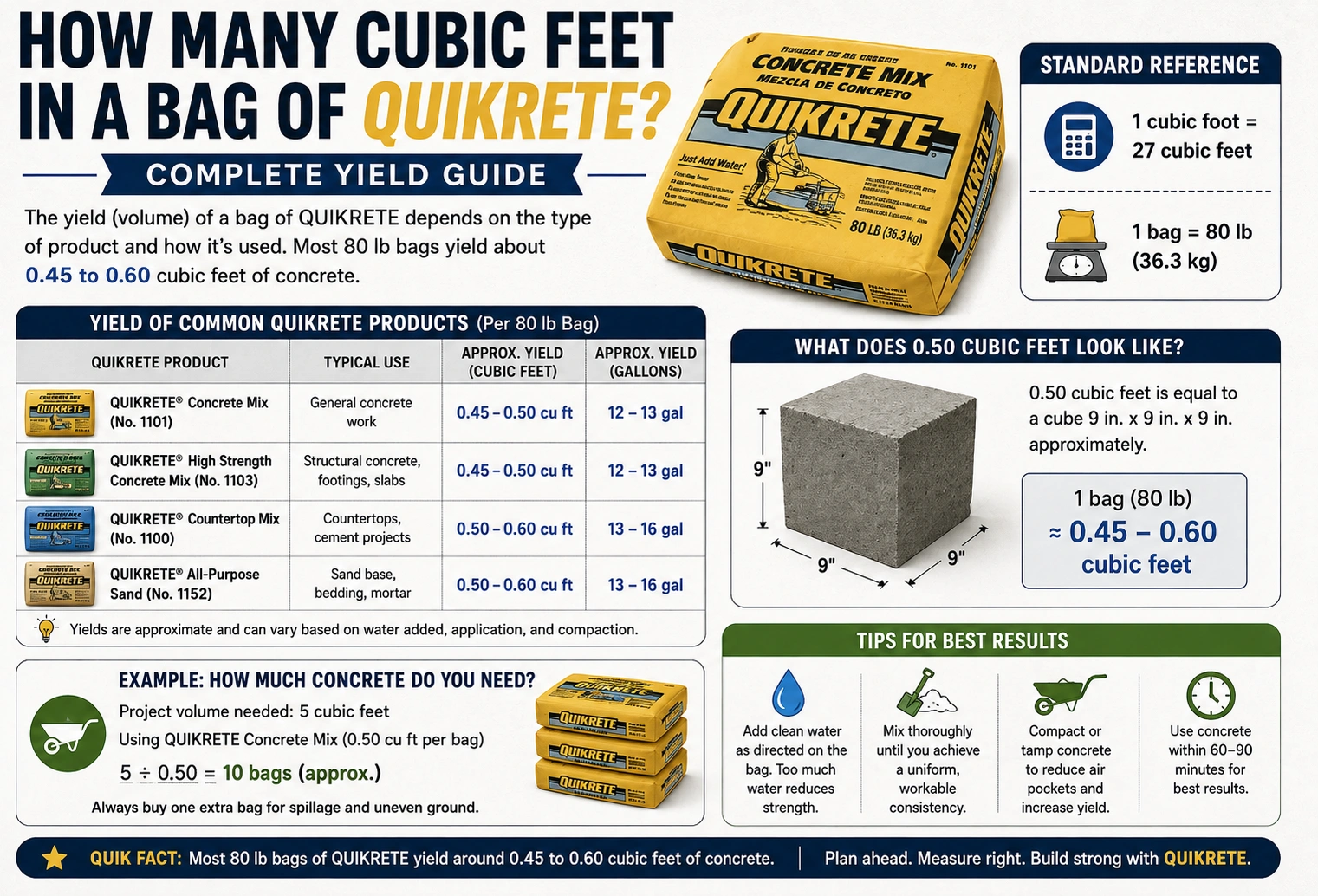
If you’re preparing for a concrete project, you may be wondering how many cubic feet are in a bag of QUIKRETE.
The answer depends on the weight of the bag. Larger bags produce more mixed concrete than smaller ones.
Typical yields are:
| Bag Size | Approximate Yield |
|---|---|
| 40 lb | 0.30 cubic feet |
| 50 lb | 0.37 cubic feet |
| 60 lb | 0.45 cubic feet |
| 80 lb | 0.60 cubic feet |
Answer:
✅ An 80-pound bag of QUIKRETE yields approximately 0.60 cubic feet of mixed concrete, while smaller bags produce proportionally less.
Quick Answer
| QUIKRETE Bag Size | Cubic Feet Yield |
| 40 lb | 0.30 cu ft |
| 50 lb | 0.37 cu ft |
| 60 lb | 0.45 cu ft |
| 80 lb | 0.60 cu ft |
These yields are approximate and may vary slightly depending on the specific product and the amount of water added during mixing.
QUIKRETE Yield by Bag Size
QUIKRETE offers several bag sizes for different types of projects.
40-Pound Bag
- Covers approximately 0.30 cubic feet
- Ideal for small repairs and patching
50-Pound Bag
- Produces about 0.37 cubic feet
- Suitable for light-duty applications
60-Pound Bag
- Yields approximately 0.45 cubic feet
- Popular for sidewalks and small slabs
80-Pound Bag
- Produces about 0.60 cubic feet
- Commonly used for fence posts, footings, patios, and larger projects
How to Calculate Concrete Volume
To determine how much concrete you need, calculate the volume of your project.
For rectangular slabs:
Multiply:
- Length (ft)
- Width (ft)
- Thickness (ft)
Example
A slab measuring:
- Length: 10 feet
- Width: 10 feet
- Thickness: 4 inches (0.33 feet)
Calculation:
10 × 10 × 0.33 = 33 cubic feet
To estimate the number of 80-pound bags:
33 ÷ 0.60 ≈ 55 bags
Always round up and purchase a few extra bags for waste or unexpected needs.
How Many Bags Do You Need?
Here’s a quick estimate using 80-pound bags:
| Concrete Volume | Bags Required |
| 1 cu ft | 2 bags |
| 5 cu ft | 9 bags |
| 10 cu ft | 17 bags |
| 20 cu ft | 34 bags |
| 30 cu ft | 50 bags |
These figures are rounded up to ensure enough material is available.
Common Concrete Projects
QUIKRETE is frequently used for:
- Fence post installation
- Sidewalks
- Patios
- Driveways
- Shed foundations
- Mailbox posts
- Concrete steps
- Footings
- Small slabs
- Repair work
Selecting the right bag size can reduce waste and make handling easier.
Factors That Affect Yield
The actual amount of usable concrete may vary due to:
- Mixing consistency
- Water content
- Product formulation
- Waste during placement
- Surface irregularities
Following the manufacturer’s mixing instructions helps achieve the intended yield.
Common Mistakes
Forgetting to Convert Inches to Feet
When calculating slab volume, convert thickness into feet before multiplying.
Buying Too Few Bags
It’s a good idea to purchase 5–10% extra to account for spills, waste, or uneven surfaces.
Using the Wrong Bag Size
Different bag weights produce different concrete volumes, so always base your calculations on the specific bag you’re using.
Expert Tips
- Measure carefully before purchasing concrete.
- Mix only what you can place before it begins to set.
- Keep extra bags in a dry location.
- Use a concrete calculator for larger or irregularly shaped projects.
9. FAQs
1. How many cubic feet are in an 80-pound bag of QUIKRETE?
An 80-pound bag yields approximately 0.60 cubic feet of mixed concrete.
2. How many cubic feet does a 60-pound bag produce?
A 60-pound bag produces about 0.45 cubic feet.
3. How many 80-pound bags make one cubic yard?
Since 1 cubic yard = 27 cubic feet, you’ll need approximately 45 bags of 80-pound QUIKRETE (27 ÷ 0.60 = 45).
4. How do I calculate how much QUIKRETE I need?
Calculate the total project volume in cubic feet, then divide by the yield of the bag size you’re using.
5. Should I buy extra concrete?
Yes. Purchasing 5–10% more than your estimate helps account for waste, spills, and uneven forms.
10. Conclusion
If you’re asking how many cubic feet in a bag of QUIKRETE, the answer depends on the bag size. A 40-pound bag yields about 0.30 cubic feet, a 60-pound bag yields around 0.45 cubic feet, and an 80-pound bag produces approximately 0.60 cubic feet of mixed concrete.
Knowing the yield of each bag makes it easier to estimate materials for patios, sidewalks, slabs, fence posts, and other concrete projects. By calculating your project’s volume and allowing a little extra for waste, you can purchase the right amount of QUIKRETE and complete the job efficiently.
Discover More Articles
How Many Feet Are in 5 Miles? Exact Conversion Guide