

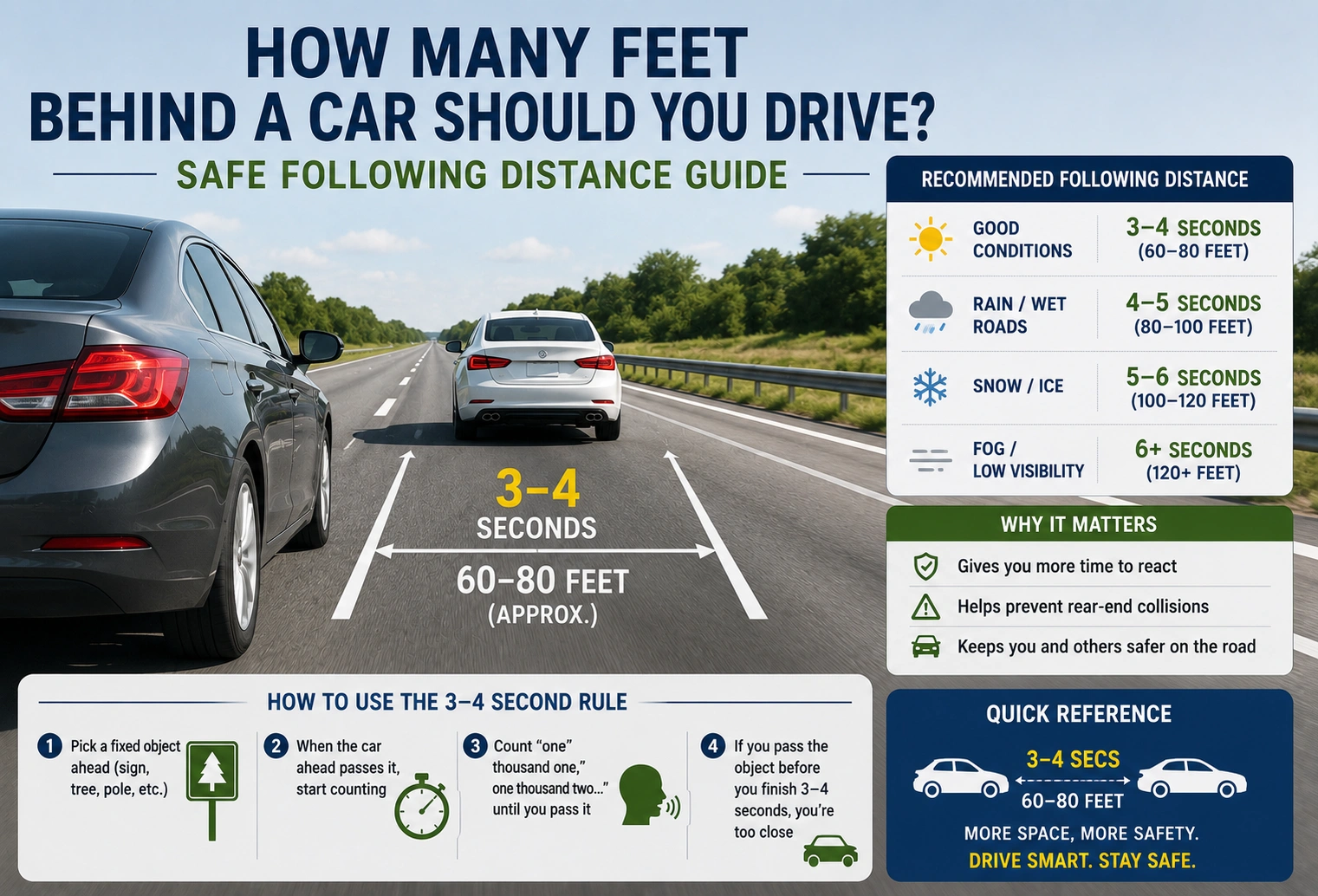
If you’re asking how many feet behind a car you should drive, the safest answer is that there isn’t a single fixed number of feet. Instead, driving experts recommend maintaining a time-based following distance, commonly known as the 3-second rule.
The number of feet between vehicles changes with speed. At higher speeds, you’ll naturally need more distance to react and stop safely.
General recommendation:
- At least a 3-second following distance in good weather and normal traffic.
- Increase to 4–6 seconds or more in rain, snow, fog, heavy traffic, or when towing a trailer.
Quick Answer
The safest practice is to maintain:
- 3 seconds behind the vehicle ahead in normal conditions.
- 4–6 seconds in poor weather or heavy traffic.
- Even more distance when driving large vehicles or on icy roads.
Answer:
✅ Instead of a fixed number of feet, use the 3-second rule to maintain a safe following distance.
Why There Isn’t One Fixed Number of Feet
A fixed distance such as 50 or 100 feet isn’t appropriate for every situation.
For example:
- At 25 mph, 100 feet may provide plenty of space.
- At 70 mph, 100 feet is far too short to stop safely.
Because reaction time and braking distance increase with speed, a time-based following distance is more accurate than measuring feet.
The 3-Second Following Rule
The 3-second rule is widely recommended because it automatically adjusts for your speed.
Here’s how to use it:
- Watch the vehicle ahead pass a fixed object, such as a sign or utility pole.
- Begin counting: “One thousand one, one thousand two, one thousand three.”
- If you reach the object before finishing the count, you’re following too closely.
- Slow down until you consistently maintain at least three seconds of separation.
This simple technique helps provide enough time to react to sudden braking or obstacles.
Approximate Following Distances by Speed
Although time is the preferred measure, the following table shows the approximate distance covered in 3 seconds at different speeds.
| Speed | Approximate Distance in 3 Seconds |
|---|---|
| 25 mph | 110 feet |
| 35 mph | 155 feet |
| 45 mph | 198 feet |
| 55 mph | 242 feet |
| 65 mph | 286 feet |
| 70 mph | 308 feet |
These values are approximate and assume constant speed on level roads.
When You Should Leave More Space
Increase your following distance when:
- Driving in rain or snow
- Roads are icy or slippery
- Visibility is poor due to fog
- Traffic is heavy
- You’re towing a trailer
- Driving a large truck or SUV
- Carrying heavy loads
More space gives you additional time to react and stop safely.
Why Following Distance Matters
Maintaining enough distance behind another vehicle helps you:
- Reduce the risk of rear-end collisions
- Improve reaction time
- Increase visibility ahead
- Avoid sudden braking
- Drive more comfortably in traffic
- Improve overall road safety
A proper following distance is one of the foundations of defensive driving.
Common Mistakes
Following Too Closely
Tailgating reduces reaction time and significantly increases the risk of a collision.
Using Feet Instead of Time
A fixed distance doesn’t adjust for speed. The 3-second rule is safer because it works at any legal speed.
Forgetting Weather Conditions
Rain, snow, and ice increase stopping distances, so you should increase your following time accordingly.
Expert Tips
- Keep your eyes focused well ahead of the vehicle in front.
- Avoid distractions such as mobile phones while driving.
- Check your mirrors regularly.
- Increase following distance at night or during poor visibility.
- Practice defensive driving habits every time you drive.
9. FAQs
1. How many feet behind a car should you drive?
There is no single recommended number of feet. Instead, maintain at least a 3-second following distance, which varies in feet depending on your speed.
2. What is the 3-second rule?
The 3-second rule means you should pass a fixed object at least three seconds after the vehicle in front passes it.
3. Should I increase my following distance in rain?
Yes. In wet or slippery conditions, increase your following distance to 4–6 seconds or more.
4. Is tailgating dangerous?
Yes. Following too closely reduces reaction time and greatly increases the likelihood of rear-end crashes.
5. Why isn’t a fixed number of feet recommended?
Because the safe distance changes with speed. A time-based following distance automatically adjusts whether you’re driving slowly or at highway speeds.
10. Conclusion
If you’re wondering how many feet behind a car you should drive, the safest guidance is not to rely on a fixed distance. Instead, use the 3-second following rule, which adjusts naturally with your speed. At highway speeds, this often translates to well over 250 feet of separation, while lower speeds require less distance.
By maintaining a proper following distance and increasing it during poor weather or heavy traffic, you’ll have more time to react, reduce the risk of collisions, and drive more safely in a wide range of road conditions.
Discover More Articles
How Many Cubic Feet in a 53′ Trailer? Complete Capacity Guide
How Many Square Feet in 10 Yards of Concrete? Coverage Guide