

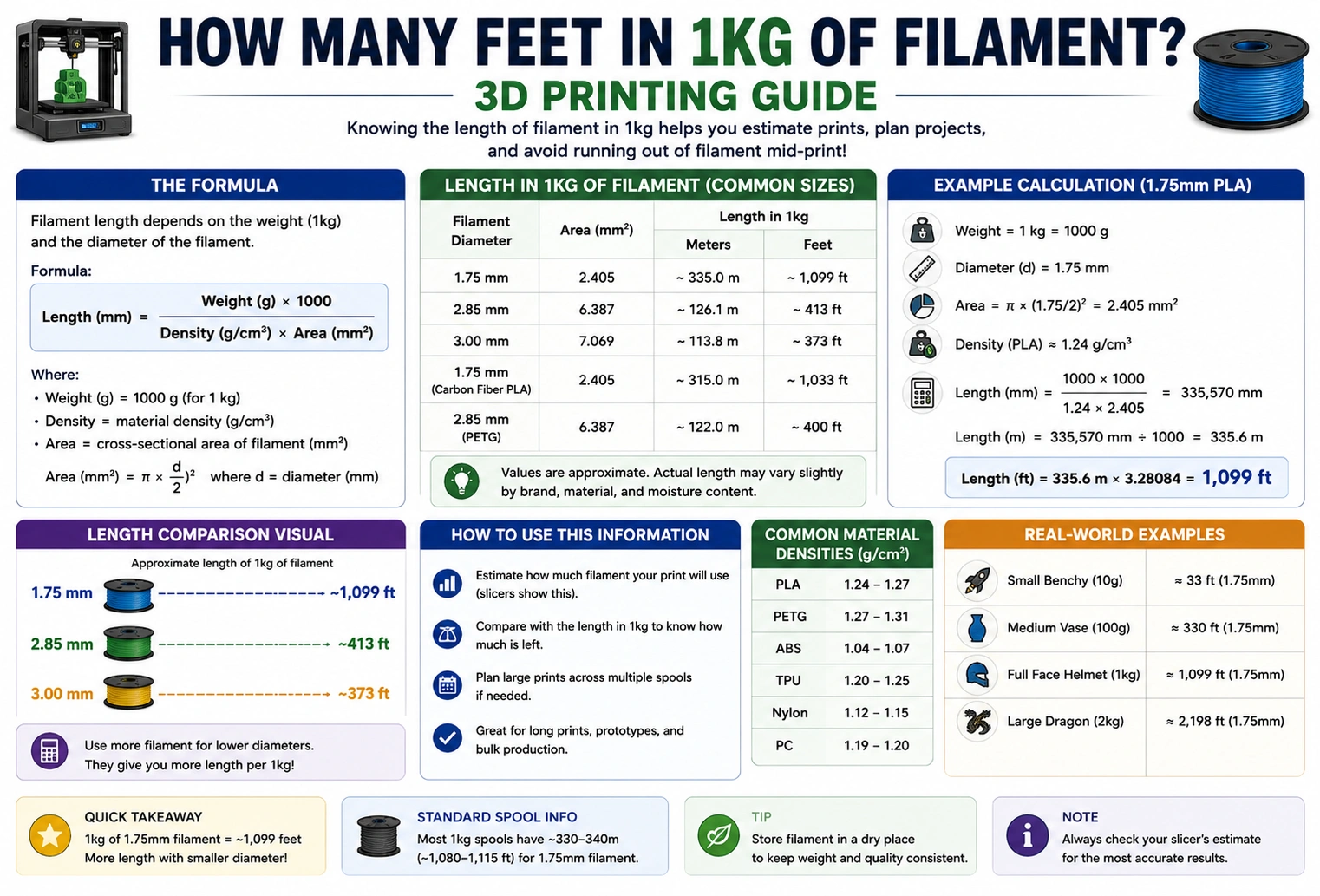
If you’re wondering how many feet are in a 1kg spool of filament, the answer depends primarily on the filament diameter and, to a smaller extent, the material’s density.
For the most common 3D printer filament sizes:
- 1.75 mm filament: approximately 1,080–1,100 feet
- 2.85 mm (or 3 mm) filament: approximately 400–420 feet
These values are approximate because different materials such as PLA, PETG, ABS, Nylon, and TPU have slightly different densities.
Quick Answer
| Filament Diameter | Approximate Length |
|---|---|
| 1.75 mm | About 1,090 feet (≈330 meters) |
| 2.85 mm | About 410 feet (≈125 meters) |
Most consumer 3D printers use 1.75 mm filament, making a 1kg spool approximately 1,090 feet long.
Why Does Filament Diameter Matter?
A 1kg spool always contains the same mass, but not the same length.
Thicker filament occupies more volume per foot, so fewer feet fit into the same 1kg weight.
For example:
- 1.75 mm filament is thinner, allowing a much longer spool.
- 2.85 mm filament is thicker, resulting in a shorter overall length.
How Is Filament Length Calculated?
Manufacturers calculate filament length using:
- Filament weight
- Material density
- Filament diameter
The simplified process considers:
- Cross-sectional area
- Volume
- Density
- Total mass
Because every material has a slightly different density, exact spool lengths vary slightly between brands.
Typical Lengths by Material
For 1.75 mm filament, common approximate lengths are:
| Material | Approximate Length |
| PLA | Around 1,090 feet |
| PETG | Around 1,050–1,080 feet |
| ABS | Around 1,090 feet |
| TPU | Slightly varies |
| Nylon | Slightly varies |
Although the differences are generally small, manufacturers may publish exact spool lengths for specific products.
Common Uses for a 1kg Spool
A single 1kg spool is enough for many printing projects, including:
- Functional prototypes
- Household organizers
- Replacement parts
- Decorative models
- Toys
- RC components
- Engineering prototypes
- Educational projects
The actual number of prints depends on model size, infill percentage, wall thickness, and support material.
What Affects Filament Usage?
Several printing settings determine how quickly a spool is consumed.
These include:
- Infill percentage
- Layer height
- Wall thickness
- Print supports
- Model size
- Nozzle diameter
- Printing temperature
Large solid objects use much more filament than lightweight models with low infill percentages.
How Much Can You Print with a 1kg Spool?
The number of objects you can print from a 1kg spool depends on the size and design of each model.
For example:
- Small keychains may use only a few grams of filament.
- Phone stands and desk organizers often require tens of grams.
- Large decorative models or functional parts may use several hundred grams.
Because every print is different, slicer software provides the most accurate estimate of filament usage before printing begins.
Estimating Print Yield
Most 3D printing slicers display:
- Estimated filament length
- Estimated filament weight
- Print time
- Material cost
These estimates help you determine whether your 1kg spool contains enough filament to complete a project before you start printing.
Tips to Make Filament Last Longer
Reduce Infill
Lower infill percentages can significantly reduce filament consumption while maintaining sufficient strength for many models.
Optimize Supports
Using fewer supports—or designing models that require minimal support—can reduce material waste.
Choose Appropriate Layer Heights
Selecting the right layer height for your project can improve printing efficiency while balancing print quality and material usage.
Preview Before Printing
Always review your slicer’s estimated filament usage to avoid running out of material during long prints.
Common Mistakes
Assuming Every 1kg Spool Has the Same Length
Not all spools contain exactly the same number of feet because material density varies slightly between PLA, PETG, ABS, Nylon, TPU, and other filament types.
Ignoring Filament Diameter
A 1.75 mm spool contains much more filament length than a 2.85 mm spool because the thinner filament occupies less volume.
Forgetting About Waste
Failed prints, calibration pieces, support structures, purge lines, and test prints all consume filament that doesn’t become part of the final object.
Improper Storage
Filament can absorb moisture from the air, especially materials such as Nylon, PETG, and TPU. Moisture may reduce print quality and increase the chance of failed prints.
Store filament in sealed containers or bags with desiccant packs when possible.
Quick Filament Length Comparison
| Spool Size | 1.75 mm Filament | 2.85 mm Filament |
|---|---|---|
| 250 g | About 270 ft | About 100 ft |
| 500 g | About 545 ft | About 205 ft |
| 1 kg | About 1,090 ft | About 410 ft |
| 2 kg | About 2,180 ft | About 820 ft |
These figures are approximate and may vary slightly depending on the material and manufacturer.
Frequently Asked Questions
How many feet are in a 1kg spool of 1.75 mm filament?
A typical 1kg spool of 1.75 mm filament contains approximately 1,090 feet (about 330 meters), although the exact length varies slightly by material.
How many feet are in a 1kg spool of 2.85 mm filament?
A 1kg spool of 2.85 mm filament is generally around 410 feet (about 125 meters) long.
Does PLA have the same length as PETG?
Not exactly. Because PLA and PETG have different material densities, spool lengths can vary slightly even when both weigh 1kg.
How can I estimate filament usage before printing?
Most slicer software calculates the estimated filament length and weight required for a print based on your model and print settings.
Can a 1kg spool print multiple large projects?
Yes. A 1kg spool is sufficient for many medium and large prints, but the exact number depends on each model’s size, infill, wall thickness, and support requirements.
Conclusion
If you’re asking how many feet in 1kg of filament, the answer depends mainly on the filament diameter. A standard 1.75 mm spool contains about 1,090 feet (330 meters) of filament, while a 2.85 mm spool contains approximately 410 feet (125 meters). Small variations are normal because different filament materials have different densities.
Understanding filament length helps you estimate print capacity, compare spool sizes, and plan projects more effectively. By checking your slicer’s material estimates and storing filament properly, you can maximize the value and performance of every 1kg spool.
Discover More Articles
How Many Cubic Feet Is a Carry-On Suitcase? Size Guide