

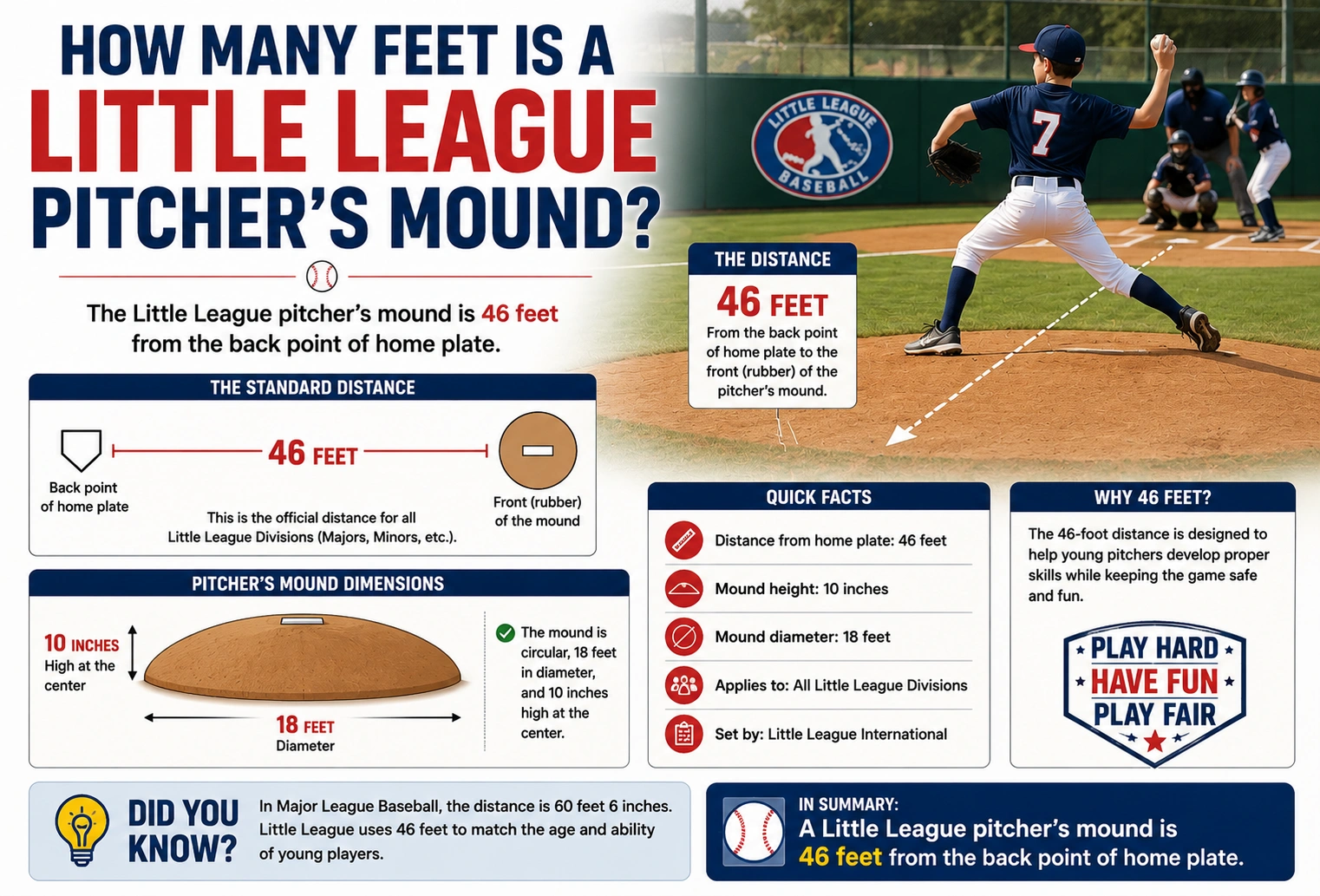
If you’re wondering how many feet is a Little League pitcher’s mound, the official pitching distance for standard Little League baseball is:
46 feet from the front edge of the pitcher’s plate to the rear point of home plate.
This is the standard pitching distance used for Little League players in the traditional youth baseball division.
Quick Answer
| Measurement | Little League |
|---|---|
| Pitching distance | 46 feet |
| Distance measured from | Front edge of pitcher’s plate |
| Home plate reference | Rear point of home plate |
| Pitching rubber width | 18 inches |
The important detail is that the 46-foot measurement is not simply the distance between the centers of the mound and home plate. Official field measurements use specific reference points on the pitching plate and home plate.
Little League Pitching Distance
For standard Little League baseball, the distance from the pitcher’s plate to home plate is 46 feet.
This shorter distance is designed for young players and is significantly closer than the pitching distance used in professional baseball.
The shorter distance allows developing pitchers to throw from a position appropriate for their age and skill level.
Pitching Rubber and Home Plate
The pitching distance is measured between two specific points.
The pitcher’s plate, commonly called the pitching rubber, is positioned on the mound.
For Little League, the front edge of the pitching plate is 46 feet from the rear point of home plate.
The pitching plate itself is 18 inches wide.
This distinction matters when constructing or measuring a Little League field because measuring from the wrong point can result in an incorrect pitching distance.
Little League Mound Dimensions
The pitcher’s mound is not simply a large raised circle with the pitcher standing anywhere inside it.
The field is constructed around the official pitching plate and surrounding mound area.
Important measurements include:
- 46 feet from the pitching plate to home plate
- 18 inches wide pitching plate
- A raised pitching area around the plate
- A level area surrounding the pitching plate
The exact mound construction and dimensions can depend on the applicable Little League division and current field specifications.
Comparison With Other Baseball Levels
Little League’s 46-foot pitching distance is shorter than the distances used at higher levels of baseball.
| Level | Approximate Pitching Distance |
| Little League | 46 ft |
| High School | 60 ft 6 in |
| College | 60 ft 6 in |
| Professional MLB | 60 ft 6 in |
This difference is important because pitching distance affects reaction time, pitch speed perception, and the overall difficulty of hitting.
As players advance through baseball, they generally move to a longer pitching distance.
Why Is Little League’s Mound 46 Feet Away?
The shorter distance is designed specifically for younger players.
At 46 feet, young hitters have more appropriate reaction time, while pitchers can develop mechanics and control without having to throw from the full adult distance.
The field dimensions are designed to match the physical development and competitive level of Little League players.
Real-World Comparisons
The 46-foot Little League pitching distance is considerably shorter than the distance used in adult baseball.
Comparing 46 Feet to Adult Baseball
A standard Little League pitching distance is:
46 feet
The pitching distance in high school, college, and Major League Baseball is:
60 feet 6 inches
That means the adult pitching distance is 14 feet 6 inches longer.
Visualizing 46 Feet
A distance of 46 feet is approximately:
- 15.3 yards
- 552 inches
- 14.02 meters
This gives coaches and field managers a useful reference when setting up a Little League field.
How to Measure the Pitching Distance
When setting up or checking a Little League field, measuring from the correct points is important.
Step 1: Locate Home Plate
Identify the rear point of home plate.
Step 2: Locate the Pitcher’s Plate
Find the front edge of the pitching plate.
Step 3: Measure the Distance
Measure directly from the rear point of home plate to the front edge of the pitching plate.
The official distance should be:
46 feet
Using the wrong reference point can make the field appear to have an incorrect pitching distance.
Common Measurement Mistakes
Measuring From the Center of Home Plate
The official measurement does not use the center of home plate as the reference point.
The measurement uses the rear point of home plate.
Measuring to the Center of the Pitching Rubber
The pitching distance is measured to the front edge of the pitcher’s plate, not simply to its center.
Assuming Every Youth Division Uses 46 Feet
Not every youth baseball program uses the same field dimensions.
Little League divisions and other youth baseball organizations can have different rules and field measurements.
Always check the applicable rules before constructing or modifying a field.
Why Pitching Distance Matters
Pitching distance affects the entire game.
A shorter distance can:
- Give hitters less time to react than a longer distance would
- Make pitches appear faster
- Affect breaking-ball movement
- Influence pitching mechanics
- Change the difficulty of hitting
As players grow and advance to higher levels, moving back to a longer pitching distance helps prepare them for advanced competition.
Frequently Asked Questions
How many feet is a Little League pitcher’s mound from home plate?
The standard Little League pitching distance is 46 feet, measured from the front edge of the pitcher’s plate to the rear point of home plate.
How far is the Little League pitching rubber from home plate?
The Little League pitching rubber is 46 feet from home plate using the official measurement points.
How wide is a Little League pitching rubber?
The pitching plate is 18 inches wide.
Is Little League pitching distance the same as MLB?
No. Little League uses a 46-foot pitching distance, while Major League Baseball uses 60 feet 6 inches from the pitching plate to home plate.
How many yards is 46 feet?
Since one yard equals three feet:
46 ÷ 3 = 15.33 yards
So, 46 feet is approximately 15.3 yards.
How many inches is 46 feet?
Since one foot equals 12 inches:
46 × 12 = 552 inches
Therefore, the Little League pitching distance is 552 inches.
Conclusion
If you’re asking how many feet is a Little League pitcher’s mound, the standard Little League pitching distance is 46 feet from the front edge of the pitcher’s plate to the rear point of home plate.
The 46-foot distance is designed for young players and differs significantly from the 60 feet 6 inches used in professional baseball. When setting up or measuring a Little League field, always use the official reference points and the rules for the specific division to ensure the field is correctly configured.
Discover More Articles
How Many 24×24 Tiles for 100 Square Feet? Easy Guide