
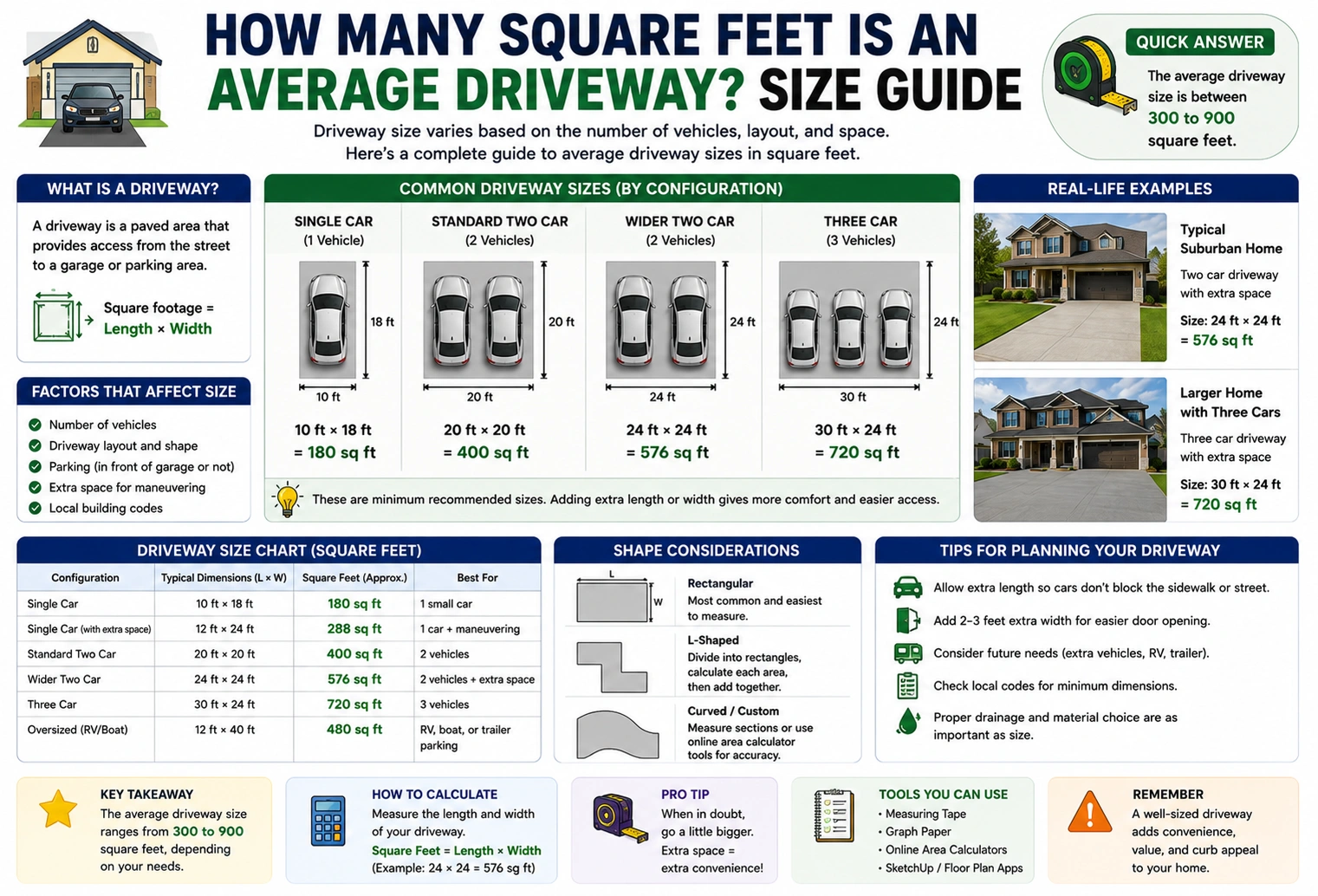
If you’re wondering how many square feet is an average driveway, the answer depends on whether the driveway is designed for one vehicle, two vehicles, or more.
Most residential driveways range from 400 to 800 square feet, with the average two-car driveway measuring approximately 20 feet wide by 20 to 40 feet long.
For example:
- 20 × 20 feet = 400 square feet
- 20 × 30 feet = 600 square feet
- 20 × 40 feet = 800 square feet
These dimensions are common for modern homes, although actual sizes vary based on lot size, local building codes, and parking needs.
Quick Answer
| Driveway Type | Typical Dimensions | Approximate Area |
|---|---|---|
| Single-Car | 10 × 20 ft | 200 sq ft |
| Small Two-Car | 20 × 20 ft | 400 sq ft |
| Standard Two-Car | 20 × 30 ft | 600 sq ft |
| Large Two-Car | 20 × 40 ft | 800 sq ft |
Most residential driveways fall between 400 and 800 square feet.
How to Calculate Driveway Square Footage
For a rectangular driveway, use the standard area formula:
Area = Length × Width
For example:
- Width = 20 feet
- Length = 30 feet
Multiply:
20 × 30 = 600 square feet
This method works for most rectangular concrete or asphalt driveways.
Common Residential Driveway Sizes
Although every property is unique, these are among the most common residential driveway dimensions.
| Width | Length | Square Feet |
| 10 ft | 20 ft | 200 sq ft |
| 12 ft | 25 ft | 300 sq ft |
| 20 ft | 20 ft | 400 sq ft |
| 20 ft | 30 ft | 600 sq ft |
| 20 ft | 40 ft | 800 sq ft |
| 24 ft | 40 ft | 960 sq ft |
These sizes provide enough space for one or two vehicles while allowing room to enter and exit comfortably.
What Affects Driveway Size?
Several factors influence how large a driveway should be.
Number of Vehicles
Homes with multiple drivers often require wider or longer driveways to accommodate additional vehicles.
Garage Size
A two-car or three-car garage usually requires a wider driveway than a single-car garage.
Local Building Codes
Some municipalities have minimum driveway width requirements or setback regulations that affect the final dimensions.
Property Layout
Lot width, landscaping, sidewalks, and nearby structures may limit how large a driveway can be.
Why Square Footage Matters
Knowing your driveway’s square footage helps estimate:
- Concrete requirements
- Asphalt quantities
- Paver materials
- Sealcoating costs
- Snow removal pricing
- Resurfacing estimates
- Construction budgets
Accurate measurements make it easier to compare contractor quotes and plan home improvement projects.
Material Estimates for an Average Driveway
Once you know your driveway’s square footage, estimating materials becomes much easier.
For example, if your driveway measures 20 × 30 feet, the total area is 600 square feet.
This information is commonly used to estimate:
- Concrete volume
- Asphalt requirements
- Paver quantities
- Gravel coverage
- Sealcoating materials
The exact amount of material needed depends on the product type and the required installation depth.
Driveway Cost Considerations
Many paving contractors calculate project costs using the total square footage.
Factors that affect the final price include:
- Driveway size
- Material type
- Thickness
- Ground preparation
- Drainage requirements
- Labor costs
- Geographic location
Larger driveways naturally require more materials and labor than smaller installations.
Popular Driveway Materials
Several materials are commonly used for residential driveways.
Concrete
Concrete is durable, long-lasting, and requires relatively little maintenance. It is a popular option for residential homes.
Asphalt
Asphalt is often less expensive to install than concrete and performs well in many climates. Periodic sealcoating helps extend its lifespan.
Pavers
Concrete or brick pavers provide an attractive appearance and allow individual sections to be repaired or replaced if needed.
Gravel
Gravel driveways are generally more affordable but require periodic maintenance to keep the surface level and replenish displaced stone.
Common Measurement Mistakes
Measuring Only the Parking Area
Some homeowners forget to include the entire driveway length from the street or property entrance to the garage.
Ignoring Curved Sections
Curved or irregular driveways should be divided into smaller sections and measured individually before calculating the total area.
Using Exterior Property Dimensions
Property size does not indicate driveway size. Always measure the actual paved or planned driveway surface.
Mixing Units
Ensure both measurements use the same unit (typically feet) before calculating square footage.
Tips for Measuring a Driveway
Measure the Width
Use a tape measure or laser distance meter to determine the driveway’s widest point.
Measure the Length
Measure from the garage door or parking area to the street or driveway entrance.
Divide Irregular Shapes
If the driveway includes curves or extra parking pads, divide it into rectangles and other simple shapes, calculate each area separately, and then add the totals.
Double-Check Measurements
Accurate dimensions help prevent ordering too much or too little paving material.
Frequently Asked Questions
How many square feet is an average driveway?
Most residential driveways measure between 400 and 800 square feet, depending on their width and length.
How large is a standard two-car driveway?
A common two-car driveway is 20 feet wide by 30 feet long, providing approximately 600 square feet of space.
How do you calculate driveway square footage?
Multiply the driveway’s length by its width:
Area = Length × Width
For example:
20 × 30 = 600 square feet
Does driveway size affect paving cost?
Yes. Contractors commonly estimate materials and labor based on the total square footage of the driveway.
Can driveway sizes vary?
Absolutely. Driveway dimensions vary depending on property size, local regulations, garage size, parking needs, and homeowner preferences.
Conclusion
If you’re wondering how many square feet is an average driveway, most residential driveways range from 400 to 800 square feet, with a 20 × 30-foot driveway (600 square feet) being one of the most common sizes. The exact dimensions depend on the number of vehicles, garage configuration, lot layout, and local building requirements.
Calculating your driveway’s square footage is simple—multiply the length by the width. Knowing the total area helps you estimate paving materials, compare contractor quotes, plan maintenance, and budget accurately for installation or resurfacing projects.
Discover More Articles
How Many Cubic Feet Is a Carry-On Suitcase? Size Guide