

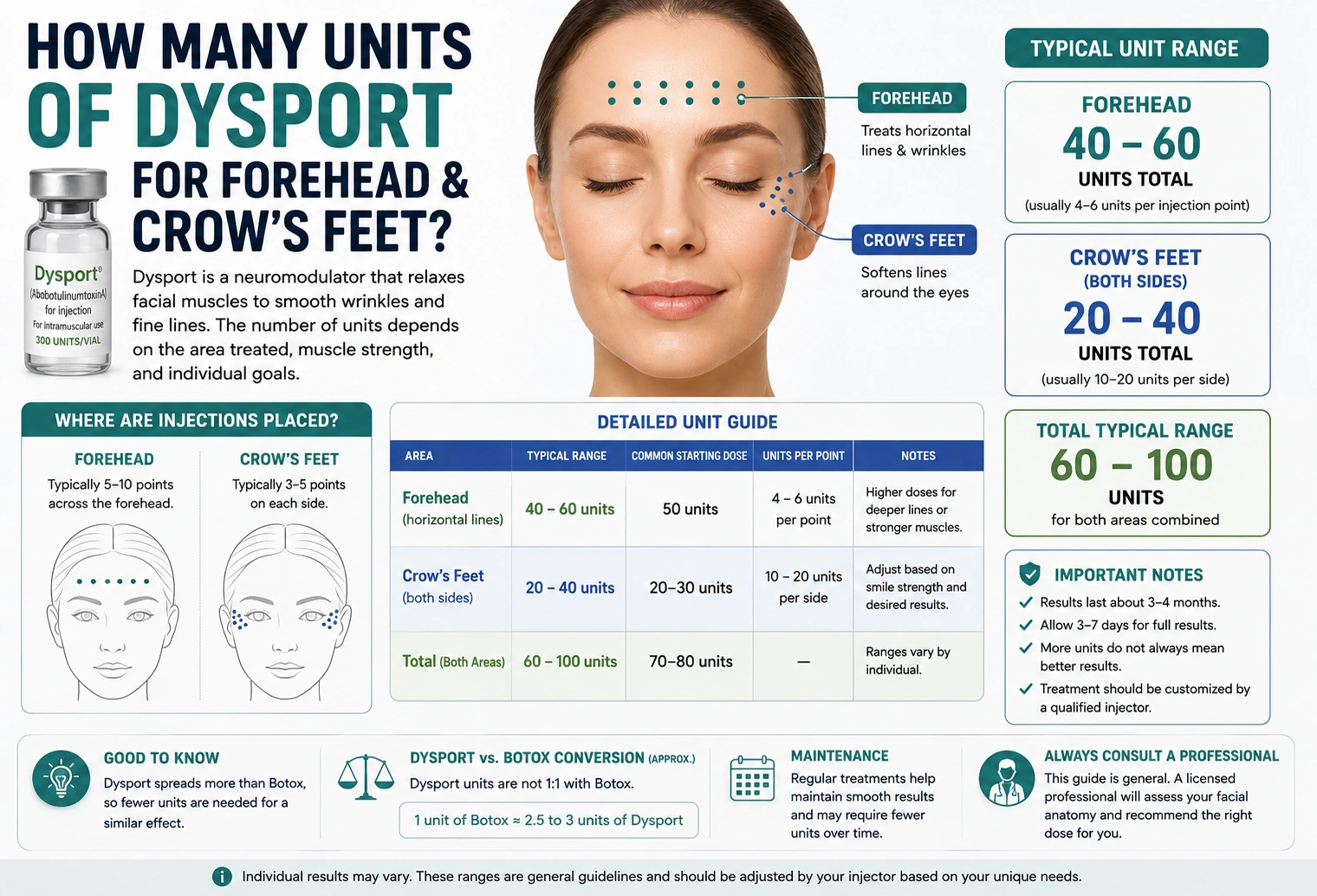
If you’re considering Dysport for forehead lines and crow’s feet, you may be wondering how many units of Dysport you need. There is no single dose that works for everyone because the appropriate amount depends on the treatment area, muscle activity, facial anatomy, wrinkle severity, and the treatment goals.
For the forehead, Dysport dosing is typically determined conservatively because the frontalis muscle helps raise the eyebrows. Treating it requires careful consideration of nearby muscles and the patient’s existing brow position.
For crow’s feet, the treatment targets the lateral portions of the orbicularis oculi muscle around the outer corners of the eyes.
Importantly, Dysport units are not directly interchangeable with Botox units. The two products have different unit systems, so a larger numerical Dysport dose does not necessarily mean a stronger treatment.
Quick Answer
There is no universal number of Dysport units for treating both the forehead and crow’s feet.
A commonly referenced starting range for cosmetic treatment may be approximately:
| Treatment Area | Typical Range* |
|---|---|
| Forehead lines | About 20–40 Dysport units |
| Crow’s feet | About 20–40 Dysport units total |
| Forehead + crow’s feet | About 40–80 Dysport units total |
*These are broad informational ranges, not a recommended dose for an individual patient. Actual dosing should be determined by a qualified medical professional after evaluating facial anatomy and muscle activity.
The FDA-approved Dysport prescribing information also provides specific dosing for glabellar lines, but cosmetic treatment of other areas, including the forehead and crow’s feet, may involve clinician-directed dosing that differs from the labeled glabellar indication.
Because the forehead is particularly sensitive to changes in muscle activity and eyebrow position, a qualified injector should determine the appropriate dose and injection pattern.
Typical Dysport Units for the Forehead
Forehead lines are horizontal wrinkles that develop primarily from repeated contraction of the frontalis muscle.
When you raise your eyebrows, the frontalis contracts and creates horizontal lines across the forehead. Dysport temporarily reduces the muscle’s ability to contract, which can soften these lines.
The amount used varies significantly between patients.
| Factor | Possible Effect on Treatment |
|---|---|
| Strong forehead muscles | May require more treatment |
| Mild muscle activity | May require less |
| Deep dynamic lines | May require a different treatment strategy |
| Existing brow position | Important when planning injections |
| Heavy or low brows | Requires particular caution |
| Desired movement | May influence dosing |
| Previous neuromodulator treatment | Previous response can help guide planning |
A provider may use a conservative approach initially and assess the response during follow-up.
The goal is generally not simply to use the largest possible number of units. The goal is to achieve an appropriate cosmetic effect while maintaining a natural facial appearance and minimizing unwanted changes to brow movement.
Typical Dysport Units for Crow’s Feet
Crow’s feet are lines that appear at the outer corners of the eyes, particularly when smiling or squinting.
They are associated with contraction of the orbicularis oculi muscle.
Dysport can be injected into carefully selected areas around the outer eye to temporarily reduce the muscle activity responsible for these dynamic lines.
A broad cosmetic range sometimes discussed for crow’s feet is approximately 10–20 units per side, or around 20–40 units total.
However, this should not be treated as a personal dosing recommendation.
The appropriate amount depends on factors such as:
- Muscle strength
- Extent of the lines
- Size of the treatment area
- Desired degree of movement
- Previous response to Dysport or another neuromodulator
- Individual facial anatomy
- Injector technique
The skin around the eyes is delicate, so accurate placement and appropriate dosing are especially important.
Combined Dysport Treatment for Forehead and Crow’s Feet
If both areas are treated during the same appointment, the total number of units is simply based on the amount selected for each treatment area.
For example, an illustrative treatment plan might look like this:
| Area | Example Range |
|---|---|
| Forehead | 20–40 units |
| Crow’s feet, both sides | 20–40 units |
| Combined total | 40–80 units |
These numbers are provided to help explain how treatment totals can be calculated. They are not a dosing recommendation.
A provider may recommend a substantially different amount depending on your facial anatomy, muscle activity, previous treatments, and desired result.
It is also important to distinguish the forehead from the glabellar region, which consists of the vertical lines between the eyebrows. Treatment of the glabella is a separate area with its own dosing considerations.
Why Dysport Dosage Varies
Two people with similar-looking wrinkles may require different amounts of Dysport.
Muscle Strength
Some people have stronger facial muscles than others. Stronger muscle activity can produce more pronounced dynamic lines and may affect the amount of neuromodulator a provider considers appropriate.
Wrinkle Severity
Dysport works primarily on dynamic wrinkles, which are lines created or worsened by muscle movement.
If lines are visible even when the face is completely relaxed, reducing muscle activity may soften them but may not completely eliminate them.
Facial Anatomy
The location, size, and movement of facial muscles vary between individuals.
This is particularly important around the forehead and eyes, where nearby muscles influence eyebrow position and eyelid function.
Desired Appearance
Some patients want substantial reduction in movement, while others want to preserve considerable facial expression.
Treatment goals can therefore influence the approach.
Previous Treatments
If you’ve previously received Dysport, Botox, or another neuromodulator, your provider can consider how your muscles responded to the previous treatment.
Dysport Units Are Not the Same as Botox Units
One of the most important things to understand when comparing cosmetic neuromodulators is that units are product-specific.
Dysport contains abobotulinumtoxinA, while Botox Cosmetic contains onabotulinumtoxinA.
Their units are established using different measurement systems.
Therefore, you should not assume that:
1 Dysport unit = 1 Botox unit
They are not directly interchangeable.
This also means that comparing treatment prices solely by the number of units can be misleading.
For example, a provider charging one price per Dysport unit cannot necessarily be compared directly with another provider charging a price per Botox unit.
Instead, compare the overall treatment plan, provider qualifications, product used, treatment area, and expected result.
What Happens During a Dysport Consultation?
A qualified medical professional should evaluate your face before determining an appropriate treatment plan.
During an assessment, the provider may examine:
- Forehead movement
- Eyebrow position
- Muscle strength
- Existing wrinkles
- Crow’s feet
- Facial symmetry
- Previous injectable treatments
- Desired cosmetic outcome
You may be asked to make facial expressions such as raising your eyebrows, frowning, or smiling so the provider can observe how the muscles move.
This assessment helps the injector determine where treatment may be appropriate and how conservative or extensive the treatment should be.
Why Forehead Treatment Requires Special Care
The frontalis muscle is different from many other facial muscles because it helps elevate the eyebrows.
If too much of its activity is reduced, or if injections are placed incorrectly, the appearance of the eyebrows can change.
Possible unwanted effects can include:
- Brow heaviness
- Changes in eyebrow position
- Eyelid or brow drooping
- Facial asymmetry
This is why forehead injections should be performed by an appropriately trained and qualified medical professional who understands facial anatomy.
More Dysport is not automatically better.
The appropriate goal is a treatment plan that balances wrinkle reduction with facial function and the patient’s desired appearance.
How Long Dysport Results Usually Last
Dysport does not permanently stop muscle movement.
Its effects gradually wear off as neuromuscular function returns.
According to prescribing information, the duration of effect can vary, and individual patients may experience different lengths of benefit.
Many cosmetic patients notice results developing within several days, with the full effect becoming clearer afterward.
The exact duration can depend on:
- Dose
- Treatment area
- Muscle activity
- Individual metabolism
- Previous treatments
- Injection technique
Because responses vary, your provider can give you a better estimate based on your treatment history.
How Often Can Dysport Be Repeated?
Repeated Dysport treatments should be planned with your healthcare provider.
The prescribing information states that treatments should generally not be administered more frequently than every three months for the approved indication.
Cosmetic treatment schedules can vary based on the area being treated and individual response.
Your provider can determine when another treatment is appropriate rather than relying on a fixed schedule.
Dysport Safety and Side Effects
Dysport is a prescription botulinum toxin product and should be administered by a qualified healthcare professional.
Potential adverse effects vary depending on the treatment area and may include:
- Injection-site discomfort
- Headache
- Bruising
- Swelling
- Temporary muscle weakness
- Eyelid or eyebrow drooping
Rare but serious effects can occur if botulinum toxin effects spread beyond the injection site.
Seek medical attention promptly if you experience symptoms such as significant difficulty swallowing, speaking, breathing, or generalized muscle weakness after treatment.
Your injector should review the product’s risks, contraindications, and precautions before treatment.
Common Questions About Dysport Units
Can you use Dysport on both the forehead and crow’s feet?
Yes, qualified providers may use Dysport for multiple facial areas when clinically appropriate. The treatment plan and dose should be individualized.
Does more Dysport mean better results?
No. Increasing the number of units does not automatically produce a better cosmetic result. Excessive treatment can increase the risk of unwanted muscle weakness or changes in facial movement.
Can I calculate my own Dysport dose?
It is not advisable to select your own dose. Dysport dosing requires consideration of facial anatomy, muscle activity, treatment goals, medical history, and injection technique.
Are Dysport and Botox units equivalent?
No. Dysport and Botox use different unit systems and should not be treated as directly interchangeable.
How much Dysport is used around the eyes?
A broad cosmetic range sometimes discussed is around 10–20 units per side for crow’s feet, but the appropriate amount varies considerably and should be determined by the treating professional.
How much Dysport is used in the forehead?
A broad cosmetic range may be around 20–40 units, but forehead treatment requires individualized assessment because the frontalis muscle affects eyebrow position.
FAQs
How many units of Dysport are needed for forehead and crow’s feet?
There is no standard dose for everyone. A broad informational range is approximately 40–80 units combined, but the actual amount should be determined by a qualified injector.
How many Dysport units for crow’s feet?
A commonly discussed cosmetic range is approximately 10–20 units per side, or 20–40 units total. Individual dosing can be higher or lower depending on anatomy and treatment goals.
How many Dysport units for forehead lines?
A broad informational range is approximately 20–40 units, although the appropriate dose varies by muscle activity, facial anatomy, and desired degree of movement.
Can Dysport treat forehead lines and crow’s feet at the same time?
Yes. Multiple facial areas can be treated during the same appointment when the provider determines that treatment is appropriate.
Is Dysport stronger than Botox?
It is not accurate to determine strength simply by comparing the numerical number of units. Dysport and Botox have different unit systems and should not be directly compared unit-for-unit.
How long does Dysport last?
The duration varies from person to person and depends on the treatment area, dose, muscle activity, and individual response. Your provider can give you a more personalized expectation.
Is Dysport safe for the forehead?
Dysport can be used in cosmetic facial treatment, but forehead injections require careful placement because the frontalis muscle influences eyebrow position. Treatment should be performed by a qualified professional.
Conclusion
If you’re asking how many units of Dysport for the forehead and crow’s feet, there is no single dose that applies to everyone.
For general educational purposes, approximately 20–40 Dysport units may be discussed for the forehead and 20–40 units total for crow’s feet, producing a broad combined range of roughly 40–80 units. However, these figures should not be used as a personal injection plan.
Dysport dosing depends on muscle strength, wrinkle severity, facial anatomy, previous treatment, and the patient’s desired level of movement. Forehead treatment deserves particular care because the frontalis muscle plays an important role in eyebrow elevation.
Most importantly, Dysport units are not equivalent to Botox units, so products should not be compared simply by numerical unit count.
The safest approach is to have a qualified medical professional assess your facial anatomy and recommend the appropriate product, injection sites, and dose for your individual goals.