
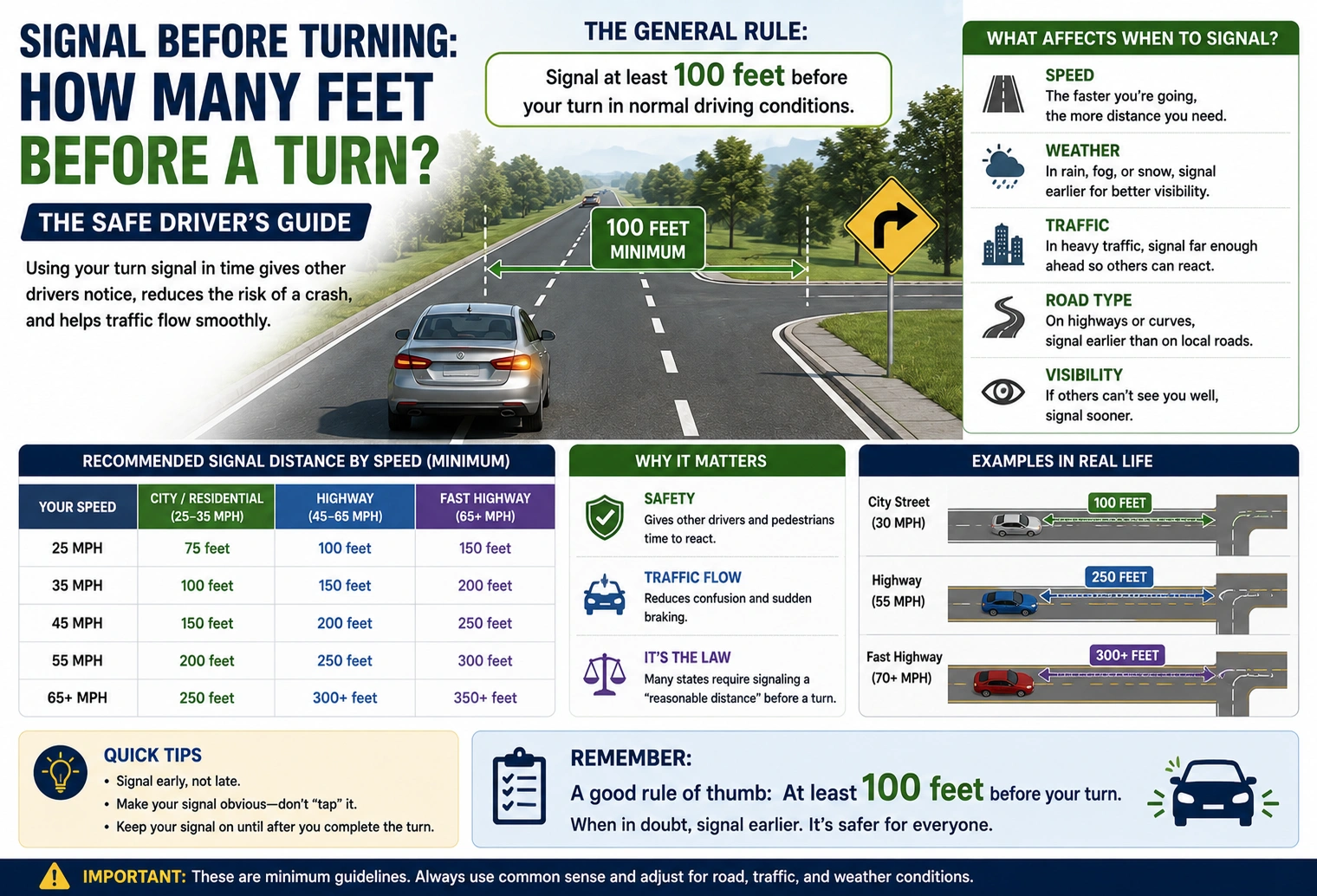
If you’re wondering how many feet before turning you should signal, a common rule in the United States is to signal approximately 100 feet before making a turn.
However, the exact legal requirement can vary by state and situation. Some jurisdictions specify a particular distance, while others use language such as signaling continuously or sufficiently in advance of the maneuver.
For that reason, drivers should follow the traffic law in the state where they are driving.
Quick Answer
For many U.S. driving situations:
Signal at least 100 feet before turning.
At higher speeds, signaling earlier can give other drivers more time to recognize your intention.
The goal is to provide enough warning without activating the signal so early that other road users become confused about where you intend to turn.
Why Should You Signal Before Turning?
A turn signal communicates your intentions to other road users.
It gives drivers, cyclists, and pedestrians additional information about what you’re about to do.
Using a signal before turning can help:
- Reduce confusion
- Give following drivers time to react
- Make intersections safer
- Communicate lane changes
- Reduce the risk of collisions
- Make your driving more predictable
A signal should be used as an advance warning rather than as a last-second announcement.
How Many Feet Before Turning Should You Signal?
The commonly cited distance is:
100 feet before turning
For example, if you’re approaching a right turn and the intersection is 100 feet ahead, you would generally activate the turn signal before reaching the 100-foot point.
However, don’t treat 100 feet as a universal legal requirement in every location.
Traffic laws differ among states and countries.
If you’re taking a driving test, use the signaling rule taught by the licensing authority in your jurisdiction.
What Does 100 Feet Look Like?
It can be difficult to judge 100 feet precisely while driving.
One hundred feet is approximately:
- 33.3 yards
- 30.5 meters
- 1/52.8 of a mile
- 1,200 inches
A useful way to visualize it is to imagine approximately one-third of a football field’s 100-yard length.
Drivers don’t normally need to measure the distance with a tape measure. The important point is to signal well before the turn so other road users have adequate warning.
Should You Signal Earlier at Higher Speeds?
Generally, giving yourself and other road users more time to recognize your maneuver is helpful, but the exact timing should follow local traffic rules and driving conditions.
At highway speeds, drivers need more time to react to lane changes and other maneuvers.
For a normal intersection turn, however, the applicable legal signaling distance may be specifically defined by local law.
Always prioritize the law and safe, predictable driving.
Signaling Before a Lane Change
Turn signals aren’t only for making left and right turns.
They should also be used when changing lanes.
The exact timing requirements can vary, but the basic principle is the same:
Signal before beginning the maneuver.
Don’t wait until you’re already moving into another lane.
A proper lane change generally involves:
- Check mirrors.
- Check the area around the vehicle.
- Activate the turn signal.
- Check again for a safe opening.
- Move gradually into the lane.
- Turn off the signal if it doesn’t cancel automatically.
A signal does not give you the right of way.
You still need to make sure the maneuver is safe.
Do You Need to Signal at a Stop Sign?
If you’re turning at a stop sign, you should generally signal your intended direction before making the turn.
For example, if you’re approaching a stop sign and intend to turn right, activate your right turn signal before reaching the intersection.
The stop sign controls your stopping requirement; the turn signal communicates your intended movement.
Both are important.
Should You Signal for a Right Turn?
Yes.
Use your turn signal before making a right turn when required by law.
The signal tells other road users that you intend to turn right.
Ideally, activate the signal early enough for drivers behind you to recognize your intention and adjust their speed or position if necessary.
Should You Signal for a Left Turn?
Yes.
Left turns can require particularly clear communication because they may involve crossing traffic or entering another roadway.
Activate the left turn signal in advance and maintain awareness of:
- Oncoming traffic
- Pedestrians
- Cyclists
- Vehicles behind you
- Traffic signals
- Road markings
The signal communicates your intention, but you remain responsible for ensuring that the turn is safe and lawful.
What Happens If You Signal Too Late?
Signaling immediately before a turn may not give other drivers enough time to respond.
For example, if you activate your signal only a few feet before turning, a vehicle behind you may not have enough time to recognize what you’re doing.
Late signaling can contribute to:
- Sudden braking
- Confusion
- Rear-end collisions
- Missed opportunities for other drivers to react
The purpose of signaling is to provide advance notice, not simply to satisfy a mechanical requirement at the moment you turn.
Can You Signal Too Early?
Yes, signaling excessively early can also create confusion.
If you activate a turn signal far before the actual turn, another driver may incorrectly assume you’re turning at an earlier driveway, intersection, or road.
The ideal timing should give sufficient warning while clearly communicating which maneuver you intend to make.
Follow local law and use reasonable judgment based on the roadway.
Turn Signal vs. Brake Lights
A turn signal and brake lights communicate different information.
Turn signal: tells other road users that you intend to turn or change lanes.
Brake lights: indicate that your vehicle is slowing or stopping.
When approaching a turn, you may need to use both.
For example:
- Activate your turn signal in advance.
- Reduce speed appropriately.
- Apply the brakes as necessary.
- Make the turn when safe.
Do not rely on brake lights alone to communicate a turn.
Is the 100-Foot Rule the Same Everywhere?
No.
This is an important point.
Traffic laws are determined by the jurisdiction where you are driving. Different states may specify different signaling distances or requirements.
For example, some jurisdictions may require signaling 100 feet before turning in certain situations, while others may specify 200 feet or use different language.
Rules can also differ for:
- Turns
- Lane changes
- Approaching intersections
- High-speed roadways
- Business districts
- Residential areas
Therefore, if you’re looking for the legal requirement, check the traffic code or driver’s handbook for your state or country.
How to Remember When to Signal
A simple driving habit is:
Signal → Check → Slow → Turn
Before turning:
- Signal your intention.
- Check mirrors and surroundings.
- Adjust your speed.
- Make sure the path is clear.
- Complete the turn safely.
The signal should become part of your normal driving routine.
Frequently Asked Questions
How many feet before turning should you signal?
A commonly used U.S. guideline is 100 feet before turning, but the exact legal requirement varies by state.
Is 100 feet the law in every state?
No. Signaling requirements vary by jurisdiction. Check your state’s current driver’s handbook or traffic laws for the exact requirement.
How many feet before a turn should you use your blinker?
For many situations, 100 feet is a common guideline. The correct legal distance depends on where you are driving.
Should you signal before turning at an intersection?
Yes. Signal your intended direction before making the turn and follow the applicable local traffic law.
Should you signal before changing lanes?
Yes. Signal before beginning a lane change, check that the maneuver is safe, and yield when required.
Is it possible to signal too early?
Yes. Signaling excessively early can cause other drivers to misunderstand which road, driveway, or intersection you intend to use.
How far is 100 feet in yards?
100 feet = 33.33 yards.
How far is 100 feet in meters?
100 feet = approximately 30.48 meters.
Does a turn signal give you the right of way?
No. A turn signal communicates your intention; it does not automatically give you the right of way. You must still make sure the maneuver is safe and lawful.
Conclusion
If you’re asking how many feet before turning you should signal, 100 feet is a common U.S. guideline, but the exact legal requirement depends on your state or jurisdiction.
The most important principle is to signal early enough to give other road users adequate warning without signaling so early that your intended turn becomes unclear.
For driving tests or legal compliance, always follow the current rules provided by your local driver’s licensing authority.
Discover More Articles
How Many BTUs to Cool 400 Square Feet? AC Guide