
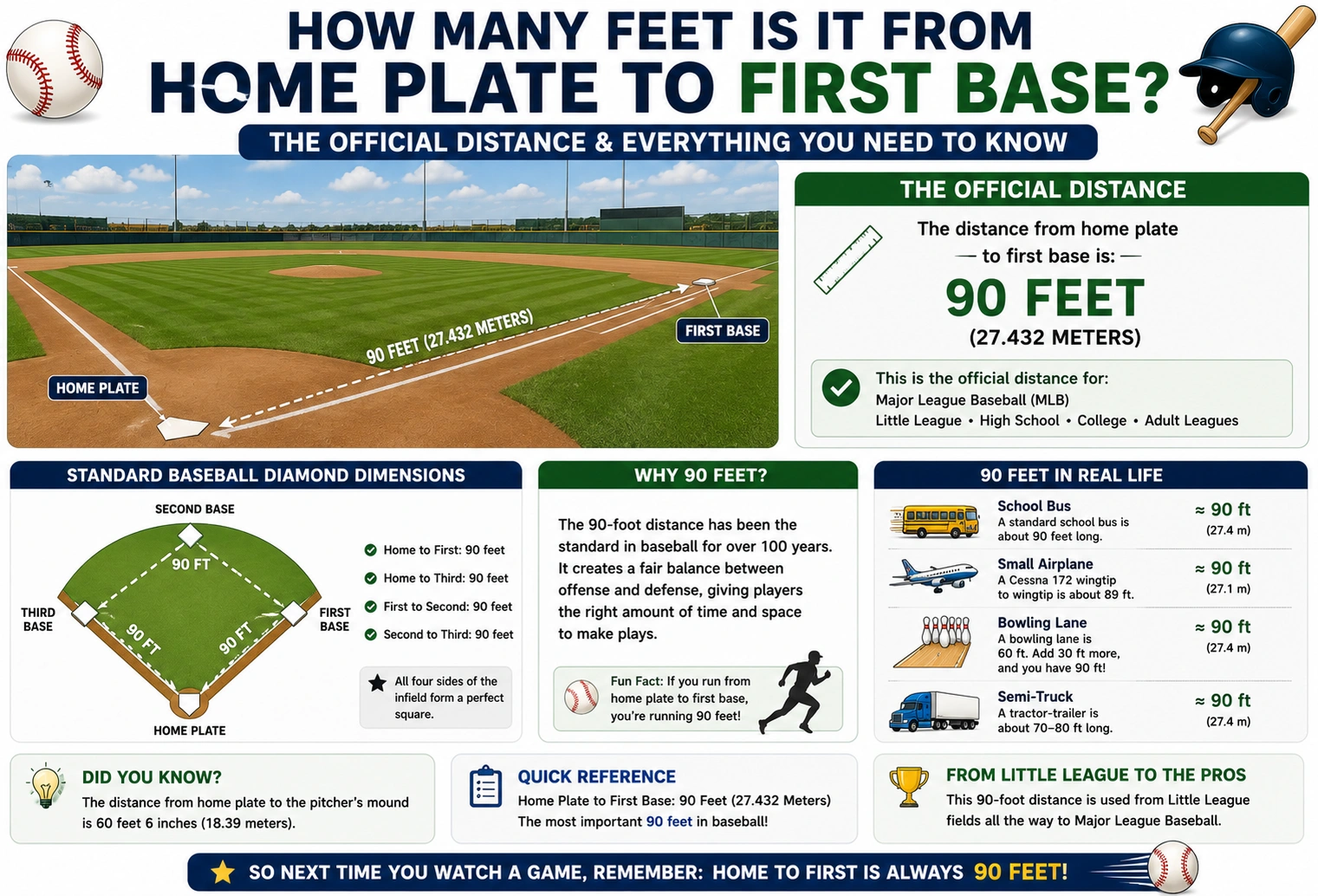
If you’ve ever watched a baseball game or helped set up a field, you may have wondered how many feet is it from home plate to first base. This measurement is one of the most important dimensions in baseball because it determines the length of the base paths, affects player speed, and influences every play on the infield.
The official distance in Major League Baseball (MLB) and most adult leagues is:
✅ 90 feet from home plate to first base.
This distance has been the standard for professional baseball for more than a century and is used on nearly every regulation baseball field.
In this guide, you’ll learn the official measurement, how it’s determined, how it varies in youth leagues, and why this distance is so important to the game.
Quick Answer
The official baseball measurement is:
- Home plate to first base: 90 feet
- Home plate to second base: Approximately 127 feet 3⅜ inches
- Distance between all bases: 90 feet
Answer:
✅ It is 90 feet from home plate to first base on a regulation baseball field.
Official Distance in Major League Baseball
Major League Baseball uses a standardized baseball diamond.
Each side of the infield square measures:
90 feet
That means the distance from:
- Home plate to first base = 90 feet
- First base to second base = 90 feet
- Second base to third base = 90 feet
- Third base to home plate = 90 feet
These dimensions create a perfectly balanced playing field for offense and defense.
Why the Distance Is 90 Feet
The 90-foot base path has become the accepted standard because it provides a competitive balance between hitters, runners, pitchers, and fielders.
If the distance were shorter:
- More infield hits would occur.
- Stolen bases would become easier.
- Defensive plays would be more difficult.
If the distance were longer:
- Fewer runners would reach base safely.
- Double plays would become easier.
- The game would favor defenders.
The 90-foot measurement creates the balance that defines modern baseball.
Baseball Field Dimensions
Here are some of the most important measurements on a regulation baseball field.
| Field Measurement | Distance |
|---|---|
| Home plate to first base | 90 feet |
| First to second base | 90 feet |
| Second to third base | 90 feet |
| Third base to home plate | 90 feet |
| Home plate to second base | 127 ft 3⅜ in |
| Pitcher’s mound to home plate | 60 ft 6 in |
These dimensions are standardized across professional baseball.
Home Plate to First Base in Different Leagues
Not every baseball league uses the same base path length.
| League | Base Path |
| Major League Baseball | 90 ft |
| NCAA Baseball | 90 ft |
| High School Baseball | 90 ft |
| Little League (Majors) | 60 ft |
| Intermediate (50/70) Baseball | 70 ft |
| Pony Baseball (varies by age) | 70–90 ft |
Younger players use shorter base paths to match their age and skill level.
How the Distance Is Measured
The 90-foot measurement is taken:
- From the rear point of home plate
- To the back corner of first base closest to foul territory
Professional field builders use surveying equipment and layout strings to ensure every base is positioned accurately.
Proper measurements are essential because even small errors can affect gameplay.
Why Accurate Measurements Matter
Correct field dimensions help ensure:
- Fair competition
- Consistent gameplay
- Accurate statistics
- Safe player movement
- Compliance with league rules
Whether you’re building a backyard field or preparing a regulation baseball diamond, accurate measurements are essential.
Real-World Example
Imagine a runner hits a ground ball to the shortstop.
The runner must sprint:
90 feet
before the first baseman catches the throw while touching first base.
Many close plays at first base are decided by only a fraction of a second, making the 90-foot distance one of the most significant measurements in baseball.
Common Misunderstandings
Measuring From the Front of Home Plate
The official measurement begins from the rear point of home plate, not the front edge.
Confusing Baseball With Softball
Most softball fields use 60-foot base paths, although dimensions vary by league.
Assuming All Youth Leagues Use 90 Feet
Many youth baseball organizations use shorter distances to accommodate younger players.
Expert Tips
- Always verify league rules before laying out a baseball field.
- Use a long measuring tape or survey equipment for accuracy.
- Measure each base path more than once before installing bases.
- Keep in mind that youth baseball and softball dimensions differ from professional baseball.
9. FAQs
1. How many feet is it from home plate to first base?
On a regulation baseball field, the distance is 90 feet.
2. Is the distance the same in Major League Baseball?
Yes. MLB uses 90-foot base paths.
3. How far is home plate from second base?
The distance is approximately 127 feet 3⅜ inches, measured diagonally across the infield.
4. Do Little League fields have 90-foot base paths?
No. Most Little League divisions use 60-foot base paths, while some older divisions use 70 feet.
5. Why are baseball base paths 90 feet?
The 90-foot distance provides a balance between offense and defense, creating the competitive gameplay seen in professional baseball.
10. Conclusion
If you’re asking how many feet is it from home plate to first base, the official answer is 90 feet on a regulation baseball field. This distance is used in Major League Baseball, college baseball, and most high school leagues, providing the standard foundation for the sport.
Understanding baseball field dimensions is helpful for players, coaches, parents, and fans alike. Whether you’re setting up a new field, studying the rules, or simply curious about the game, knowing that home plate to first base is 90 feet gives you a better appreciation of baseball’s precision and strategy.
Discover More Articles
How Many Square Feet Is an Average Driveway? Size Guide
2 Cubic Feet of Mulch Is How Many Yards? Easy Conversion Guide