
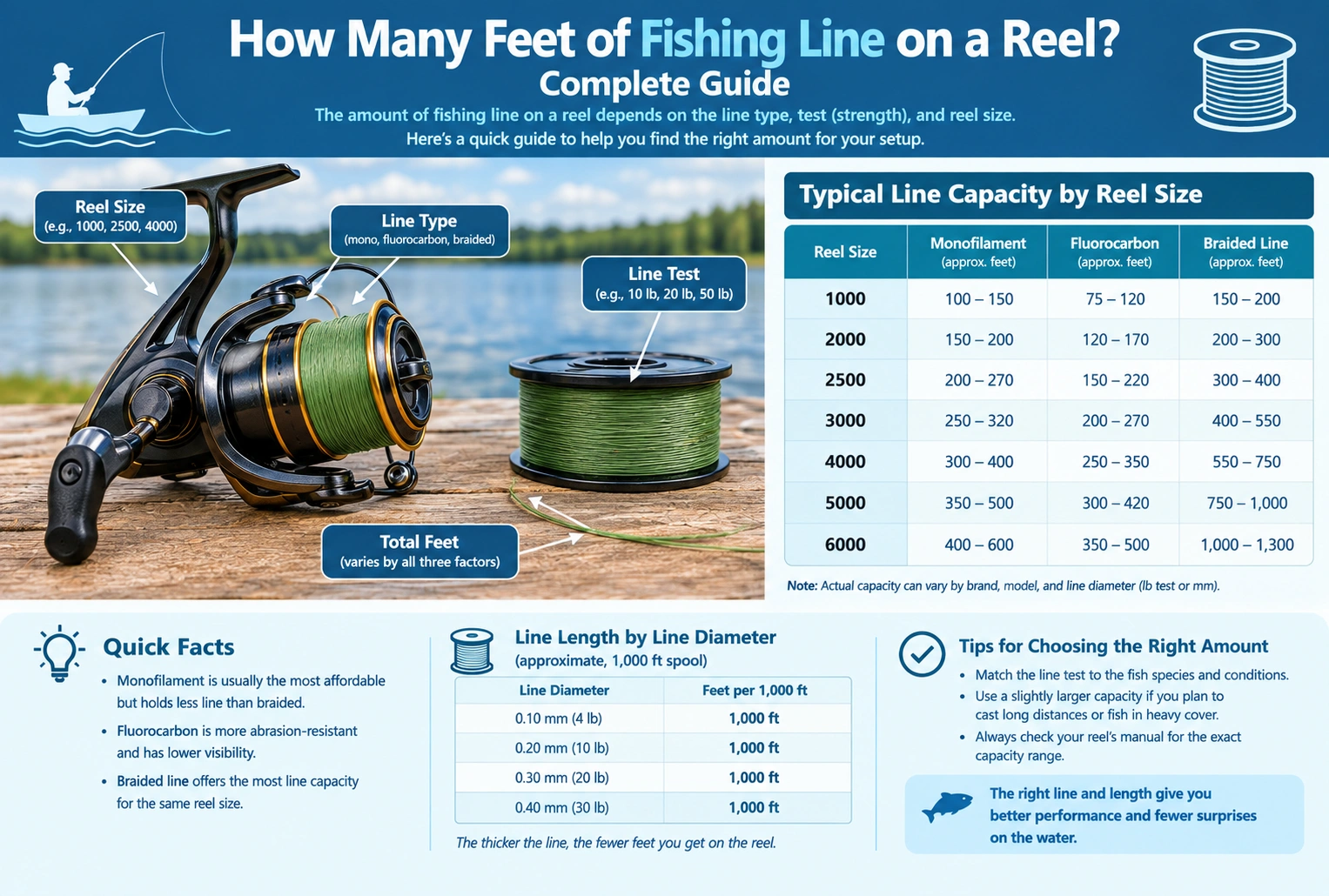
A fishing reel can hold anywhere from about 100 to 300+ yards of fishing line, depending on the reel size, line diameter, and fishing-line type. Since 1 yard equals 3 feet, that is roughly 300 to 900+ feet of line.
Many common freshwater spinning reels hold around 300–600 feet of fishing line, while larger reels designed for heavier fishing can hold considerably more.
| Fishing Reel Type | Typical Line Capacity | Approx. Feet |
|---|---|---|
| Small spinning reel | 100–150 yards | 300–450 ft |
| Medium spinning reel | 150–200 yards | 450–600 ft |
| Large spinning reel | 200–300 yards | 600–900 ft |
| Baitcasting reel | 100–150 yards | 300–450 ft |
| Large conventional reel | 200–500+ yards | 600–1,500+ ft |
The exact capacity is always determined by the reel’s spool specifications and the diameter of the line.
How Many Feet of Fishing Line Are on a Reel?
When someone asks how many feet of fishing line on a reel, there is no single answer for every reel. Reel capacity changes based on the size of the spool, the diameter of the fishing line, and the type of line being used.
Fishing-line capacity is normally printed on the reel or listed by the manufacturer in yards rather than feet. For example, a reel might be rated for 150 yards of 10-pound-test monofilament.
To convert that to feet:
150 yards × 3 = 450 feet
So, a reel holding 150 yards has approximately 450 feet of line.
Why Reel Capacity Is Different
Two reels that look similar may hold different amounts of line because their spool dimensions and recommended line sizes differ.
A thinner line takes up less space on the spool, allowing more total feet of line. A thicker line takes up more space, reducing the amount that fits.
This is why you should not estimate capacity from the reel size alone.
How Many Yards and Feet of Line Does a Reel Hold?
Most manufacturers list capacity in yards. The basic conversion is easy:
1 yard = 3 feet
| Line on Reel | Equivalent Feet |
|---|---|
| 50 yards | 150 feet |
| 75 yards | 225 feet |
| 100 yards | 300 feet |
| 125 yards | 375 feet |
| 150 yards | 450 feet |
| 175 yards | 525 feet |
| 200 yards | 600 feet |
| 250 yards | 750 feet |
| 300 yards | 900 feet |
| 400 yards | 1,200 feet |
| 500 yards | 1,500 feet |
This conversion works regardless of whether you’re using monofilament, fluorocarbon, or braided line.
How Many Feet of Fishing Line Does a Spinning Reel Hold?
Spinning reels are available in many sizes, from very small reels for ultralight fishing to large reels for saltwater applications.
A typical small or medium spinning reel may hold approximately 300–600 feet of line, although the actual capacity can be lower or much higher.
| Spinning Reel Size | Approximate Line Capacity | Approximate Feet |
|---|---|---|
| 500–1000 | 75–150 yards | 225–450 ft |
| 1500–2500 | 100–200 yards | 300–600 ft |
| 3000–4000 | 150–250 yards | 450–750 ft |
| 5000–6000 | 200–300+ yards | 600–900+ ft |
| 8000+ | 250–500+ yards | 750–1,500+ ft |
These are general ranges rather than universal specifications. A particular reel can have a different capacity.
How Line Diameter Affects How Many Feet Fit
Line diameter is one of the biggest factors affecting reel capacity.
A thick fishing line takes up more room on the spool. A thinner line takes up less room, so more feet can fit.
For example, suppose a reel has enough spool space for approximately 150 yards of a relatively thin line. Switching to a substantially thicker line may reduce the amount of line that can be loaded.
| Line Characteristic | Effect on Reel Capacity |
|---|---|
| Thinner line | More feet fit |
| Thicker line | Fewer feet fit |
| Small diameter braid | Often allows high capacity |
| Large diameter braid | Reduces capacity |
| Heavy monofilament | Takes more spool space |
| Light monofilament | Takes less spool space |
This is why a reel’s capacity should be checked using the line diameter or manufacturer rating, not just the pound-test number.
Does Pound Test Determine How Many Feet Are on a Reel?
Not by itself.
Pound test describes the approximate strength rating of fishing line, but two different lines with the same pound-test rating can have different diameters.
For example, braided line is usually much thinner than monofilament at comparable strength. As a result, a reel can often hold substantially more feet of braid than thicker line.
Pound Test vs. Diameter
| Factor | What It Tells You |
|---|---|
| Pound test | Approximate breaking strength |
| Line diameter | How much physical space the line occupies |
| Reel size | Approximate spool capacity |
| Spool dimensions | Available space for line |
| Line type | Can significantly change diameter |
For capacity calculations, diameter is more directly important than pound-test strength.
How Many Feet of Fishing Line Do You Actually Need?
You do not necessarily need to fill a reel with hundreds or thousands of feet of line.
The amount you need depends on your fishing style, target species, water depth, casting distance, and how much line your reel is designed to hold.
For many ordinary freshwater applications, having several hundred feet available is more than enough.
| Fishing Situation | Approximate Line Amount |
|---|---|
| Small pond fishing | 200–400 ft |
| Bass fishing | 300–600 ft |
| General freshwater fishing | 300–600 ft |
| Long-distance casting | 400–600+ ft |
| Deep-water fishing | 600+ ft may be useful |
| Offshore/saltwater fishing | 600–1,500+ ft may be needed |
These figures describe the amount of line you might want available, not a universal amount that must be loaded.
How Much Line Should You Put on a Spinning Reel?
A spinning reel is normally filled close to its recommended spool capacity, but you should not simply add as much line as possible without checking the reel specifications.
For many spinning reels, the line should be loaded so that there is only a small amount of spool lip showing.
A commonly used approach is to leave approximately 1/8 inch of space from the edge of the spool rather than filling completely to the lip.
This helps reduce problems such as excessive loops and line falling off the spool.
Why Proper Spooling Matters
Too little line can reduce casting distance because the line has to travel over a larger portion of the spool lip.
Too much line can create problems such as:
- Line loops
- Wind knots
- Line slipping off the spool
- Tangles
- Uneven line release
The goal is a properly filled spool rather than simply maximizing the number of feet.
How Many Feet of Fishing Line Are on a Baitcaster?
Baitcasting reels commonly hold around 100–150 yards of fishing line for many freshwater applications.
That equals approximately 300–450 feet.
| Baitcaster Capacity | Feet |
|---|---|
| 100 yards | 300 ft |
| 125 yards | 375 ft |
| 150 yards | 450 ft |
| 200 yards | 600 ft |
The exact capacity varies by model and line diameter.
A baitcaster designed for heavier fishing may have a larger spool and significantly greater capacity than a compact freshwater model.
How Many Feet of Braided Line Can a Reel Hold?
Braided fishing line is usually thinner than monofilament of similar strength. Because of this, braid can provide excellent line capacity for its strength rating.
However, braid capacity still depends on the actual diameter and the reel’s spool specifications.
For example, a reel that holds 150 yards of a particular monofilament may hold more than 150 yards of a thinner braid.
| Line Type | General Capacity Effect |
|---|---|
| Thin braid | Usually allows more line |
| Thick braid | Allows less line |
| Thin monofilament | Moderate-to-high capacity |
| Thick monofilament | Lower capacity |
| Fluorocarbon | Often takes more spool space than thin braid |
Always compare the manufacturer’s capacity using the specified line diameter.
How to Calculate How Many Feet Are on a Reel
If you know the number of yards on the spool, the calculation is extremely simple.
Formula
Feet = Yards × 3
For example, if your reel contains 200 yards:
200 × 3 = 600 feet
So, 200 yards equals 600 feet.
More Examples
| Reel Capacity | Calculation | Total Feet |
|---|---|---|
| 100 yards | 100 × 3 | 300 ft |
| 125 yards | 125 × 3 | 375 ft |
| 150 yards | 150 × 3 | 450 ft |
| 200 yards | 200 × 3 | 600 ft |
| 250 yards | 250 × 3 | 750 ft |
| 300 yards | 300 × 3 | 900 ft |
If the reel specification is already given in yards, no complicated calculation is necessary.
How Many Feet of Line Are Needed to Fill a Reel?
If you’re replacing old line, you may want to know exactly how much new line is required.
The easiest method is to use the reel’s printed capacity.
For example, if the spool says:
10 lb test: 150 yards
Then the full capacity is:
150 × 3 = 450 feet
Therefore, approximately 450 feet of the specified line would fill the spool under the manufacturer’s stated conditions.
However, the actual amount may vary if your line has a different diameter from the line used for the capacity rating.
Does Backing Change How Much Fishing Line You Need?
Yes.
Many anglers use backing underneath the main fishing line. Backing fills part of the spool, allowing you to use less expensive main line while still maintaining a properly filled spool.
For example, instead of filling a large spool entirely with expensive braid, you can put backing on first and then add your desired amount of braid.
| Spooling Method | Main-Line Requirement |
|---|---|
| Entire spool with main line | More main line |
| Backing + main line | Less main line |
| Half spool with backing | Reduced main-line cost |
| Manufacturer-rated full spool | Follow stated capacity |
The exact amount of backing depends on the reel, line diameter, and desired final fill level.
Fishing Line Capacity: Reel Size Comparison
A larger reel generally has a larger spool and can accommodate more line, but reel-number systems are not perfectly standardized between manufacturers.
| Reel Category | Typical Use | General Capacity |
|---|---|---|
| Ultralight | Small fish, light tackle | 225–400 ft |
| Small | Panfish and light freshwater | 300–450 ft |
| Medium | Bass and general freshwater | 400–600 ft |
| Large | Larger fish and saltwater | 600–900+ ft |
| Heavy-duty | Offshore and big fish | 900–1,500+ ft |
Treat these numbers as planning ranges rather than exact specifications.
How Many Feet of Fishing Line Are on a 300-Yard Spool?
A 300-yard spool contains:
300 × 3 = 900 feet
So, a 300-yard fishing-line spool contains 900 feet of line.
This does not mean 900 feet will necessarily fit on every reel. The reel’s capacity depends on line diameter.
How Many Feet of Fishing Line Are on a 150-Yard Spool?
A 150-yard spool contains:
150 × 3 = 450 feet
Therefore, 150 yards equals 450 feet.
Whether all 450 feet should be put onto your reel depends on the reel’s capacity.
How Long Does Fishing Line Last on a Reel?
Fishing line does not have one universal replacement schedule.
Its usable life depends on exposure to sunlight, water, abrasion, heat, storage conditions, fishing frequency, and the type of line.
Inspect your line regularly for:
- Fraying
- Nicks
- Flat or damaged sections
- Severe memory
- Discoloration
- Weak spots
- Abrasion damage
If the line is visibly damaged or has become unreliable, replacing it is generally better than trying to maximize its remaining length.
Common Mistakes When Measuring Fishing Line Capacity
1. Assuming Every Reel Holds the Same Amount
Reel sizes are not universal capacity measurements. Always check the manufacturer’s specifications.
2. Confusing Yards With Feet
A 200-yard capacity is not 200 feet.
200 yards = 600 feet.
3. Ignoring Line Diameter
Two lines with the same pound-test rating may occupy different amounts of space.
4. Overfilling the Spool
Adding too much line can cause tangles and poor line management.
5. Using the Wrong Capacity Rating
A reel may list different capacities for different line diameters. Make sure you are using the rating that matches your line.
6. Measuring Only the Reel Size
A larger reel generally has more capacity, but spool width, diameter, depth, and line diameter all matter.
How to Choose the Right Amount of Fishing Line
Before spooling a reel, check these four things:
- Reel model and spool capacity
- Fishing-line type
- Line diameter
- Recommended pound test
Then compare your line with the manufacturer’s capacity rating.
If the reel says it holds 150 yards of a particular line, that equals 450 feet.
For a different line, use its diameter and the manufacturer’s capacity chart rather than assuming the same 450 feet will fit.
Frequently Asked Questions
How many feet of fishing line are on a typical reel?
A typical reel may hold approximately 300–600 feet of fishing line, although small reels may hold less and large reels can hold 900 feet or more.
Is 300 feet of fishing line enough?
For many freshwater fishing situations, 300 feet can be enough. The amount you need depends on casting distance, water depth, target species, and how much line your reel is designed to hold.
How many feet are in 100 yards of fishing line?
There are 300 feet in 100 yards because one yard equals three feet.
How much line should I put on my reel?
Use the reel manufacturer’s recommended capacity for your particular line diameter. For many spinning reels, the spool is filled close to the lip while leaving a small gap rather than completely filling over the edge.
Does braided line give you more feet on a reel?
Often, yes. Because braid can have a smaller diameter than monofilament at similar strength ratings, it can allow more line to fit on the same spool. The actual capacity depends on the specific line and reel.
Conclusion
So, how many feet of fishing line are on a reel? There is no single number because fishing reels come in many sizes and line has different diameters. A common reel may hold around 300–600 feet, while larger reels can hold 900–1,500 feet or more.
The easiest way to determine the amount is to check the reel’s capacity rating. If it is listed in yards, multiply the number of yards by 3 to convert it to feet. For example, 150 yards = 450 feet, while 300 yards = 900 feet.
For accurate spooling, always consider the reel size, spool dimensions, line diameter, and line type rather than relying on reel size alone.
Discover More Articles
How Many Square Feet Will 15,000 BTU Heat?